



When people talk about cold shower benefits, the conversation often swings too far in one direction or the other. Either cold showers are treated like a miracle habit that fixes everything, or they are dismissed as another wellness trend for people who like to make life harder than it needs to be.
The truth is more useful than that.
A cold shower can feel like a reset. It can wake you up quickly, sharpen your attention, and make you feel more present in your body. For some people, it also becomes a simple way to practice staying steady when the body wants to tense up and rush. But it is not magic, and it is not automatically a good idea for everyone. The strongest evidence still fits better with benefits like alertness, stress adaptation, and routine value than with dramatic claims about healing or metabolism.
Quick Answer
Cold showers may help with alertness, mood, recovery, and stress resilience, and they can teach you a lot about how you breathe under pressure. But they are not a cure-all, they are not proven lung-healing therapy, and they are not the right fit for every body. If cold tends to tighten your chest, trigger coughing, or make your breathing feel chaotic, a gentler approach is smarter than forcing the habit. If you have heart, lung, or other health issues, talk with your own doctor before making deliberate cold exposure a regular routine.
At a Glance
| Question | Short answer |
| Do cold showers wake you up? | Often yes. That is one of the clearest short-term effects people report, and it matches the body’s immediate response to sudden cold. |
| Do they help mood and resilience? | Possibly. Recent research suggests potential benefits for stress, wellbeing, and sleep quality, but the evidence is still mixed. |
| Do they help breathing? | Not by healing lungs. The more realistic benefit is learning to stay calmer once the first gasp response hits. |
| Do they help metabolism through brown fat? | Cold can activate brown fat, but that does not automatically mean short cold showers create major metabolic change. |
| Can they backfire? | Yes. Cold can worsen airway symptoms in some people and creates a clear cardiovascular stress response. |
The short version is simple: cold can be useful, but it needs context, dose, and common sense.
Anita’s Øresund Routine
My own relationship with cold started gently, not dramatically.
I began in the early autumn, not in the middle of winter, because I wanted my body to adapt gradually instead of turning it into a shock challenge. That made a huge difference. By the time the colder months arrived, the water no longer felt like something I had to fight. It felt like something I understood better.
For me, the real value is not just the cold itself. It is the whole experience. The sunrise, the air, the silence, the shock of the water, and then that moment where the body stops resisting and settles. That is why real photos matter here too. They make the article feel honest and lived-in instead of generic.
What I would never say is that everyone needs to winter bathe or take cold showers to be healthy. I would say that, when approached gradually and respectfully, cold can become a very real practice in body awareness, steadier breathing, and mental reset.
Also in This Article
- Why cold hits the breath so hard at first
- Cold Shower Benefits: What feels real in daily life
- What tends to be overhyped
- What about brown fat
- When to skip the cold
- How to start in a sane way
- FAQ
Why Cold Hits the Breath So Hard at First
The first few seconds are the whole story.
Cold usually does not make you calm right away. It usually does the opposite. Breathing speeds up, the heart works harder, and there is that familiar urge to gasp, tense, and pull away. That is part of the cold shock response. The American Heart Association notes that sudden cold exposure can rapidly increase breathing, heart rate, and blood pressure.
That is one reason cold can feel so intense from a breathing perspective. It exposes your pattern immediately. Do you hold your breath, over-breathe, brace your shoulders, or lose the exhale? That can actually be useful information.
Cold on the face is also one reason many people describe the experience as strangely focusing once the first shock passes. It is often discussed in relation to the diving response and parasympathetic activity, but it is better to keep that explanation modest than to turn it into a grand “vagus hack” claim. What matters in practice is simpler: if you can lengthen the exhale and stay present, the experience often shifts from panic to steadiness.
If cold already irritates your chest, that matters too. Asthma + Lung UK says cold air can narrow the airways, increase mucus, and worsen coughing, wheezing, and breathlessness in some people.
Supercharge cold showers with Wim Hof breathing → Exploring the Wellness Benefits of Wim Hof Method
Cold Shower Benefits: What Feels Real in Daily Life
1. Energy and alertness
This is probably the most believable benefit.
A cold shower can cut through grogginess fast. It feels like a clean jolt. Not gentle, not mystical, just immediate. The body wakes up. For some people, that makes it a better morning reset than another coffee. That lines up with what happens physiologically when cold triggers a strong arousal response.
2. Mental reset
A lot of people do not use cold showers because they love cold. They use them because cold demands attention.
You cannot drift through the moment in the same way once cold water hits. It pulls you into the present. The 2025 systematic review found some evidence of improved wellbeing and lower stress later after cold-water exposure, though not necessarily immediate calm in the moment. That distinction matters. Cold is often a stressor first and a reset later.
3. Stress tolerance
Cold is a controlled stressor. In a small dose, it can become a way to practice not panicking when your body feels challenged.
But the key is dose. If the cold pushes you into chaos every time, you are not building calm. You are rehearsing overwhelm. The current evidence suggests possible benefits for stress and wellbeing, but not a free pass to turn cold into punishment.
Calm your nervous system before icy showers → Simple Breathing Techniques for Anxiety
4. Recovery
Cold exposure has been used in recovery culture for years. The evidence is not clean enough to say it works equally well for everyone, but there is enough signal to say it may help some people with perceived soreness, recovery, sleep quality, and quality of life in the right context. More is not automatically better.
5. Breathing awareness
This is the breathing benefit that feels most honest.
A cold shower can reveal whether you are mouth breathing, gasping, over-breathing, or tightening your whole rib cage the second something uncomfortable happens. That is useful. It is not the same thing as saying cold showers improve lung function clinically. It is more honest to say they expose your pattern and give you a chance to work with it.
Master breath holds that make cold plunges easier → Guided Breathing Techniques for Beginners
6. Grounding
A lot of people describe cold as grounding, and that word makes sense here.
The intense sensory input can pull attention away from looping thoughts and back into the body. It is not that cold magically fixes your mind. It is that the body becomes impossible to ignore for a moment, and that can feel clarifying.
What Tends to Be Overhyped
“It heals your lungs”
That is too much. The current evidence does not support cold showers as a direct lung-healing treatment. Most published work is about wellbeing, stress, recovery, and cold-water exposure in broader populations, not lung-recovery protocols.
“It boosts immunity dramatically”
That is too strong too. There are interesting findings, but not enough to justify big promises. The 2025 review found some encouraging signals, while the 2016 Dutch cold-shower trial found lower sickness absence from work without showing fewer illness days. Interesting, yes. Proof of a dramatic immune shield, no.
“If it feels brutal, it must be working”
No. That mindset ruins a lot of potentially good habits. A cold shower should not become a daily test of toughness. If it makes your chest clamp down, your breathing spiral, or your whole nervous system feel battered, it is not a smart ritual just because it is intense. The evidence does not support “more suffering equals more benefit.”
Nasal breathing unlocks cold shower recovery benefits → Nasal vs Mouth Breathing Pros and Cons
What About Brown Fat
Brown fat is one reason cold exposure gets so much metabolic attention.
Brown adipose tissue helps generate heat, and cold exposure can activate it in humans. That part is real. But it is also where people tend to jump too far. A 2024 systematic review and meta-analysis found that cold-exposure-induced brown fat activation was metabolically interesting, yet pooled fasting data did not show significant changes in glucose, insulin, or triglycerides. The only significant pooled change was an increase in free fatty acids.
So brown fat is worth mentioning, but not overselling. It is better treated as an interesting mechanism than as proof that short cold showers will transform metabolism.
Hot-cold contrast breathing for ultimate energy → Sauna Breathwork Benefits Heat Cold Plunge
How to Start in a Sane Way
Most people should start much smaller than they think.
- Take your normal warm shower.
- Turn the water cooler for the last 20 to 30 seconds.
- Keep your face out of it at first.
- Focus on a slow exhale.
- Stop before it turns into a battle.
- Repeat a few times a week.
That is enough.
You do not need to start with long minutes of suffering. A shorter, repeatable habit is far better than an extreme one you secretly dread.
Some people also like to do a short round of controlled breathing on land before a cold shower or sea dip so they enter the experience less tense. If you use a Wim Hof-style breathing approach, keep the safety rule absolutely clear: do it seated or lying down on land, never in water, never while driving, and never anywhere loss of consciousness would be dangerous. The official Wim Hof Method guidance explicitly warns about this.
Build lung power for cold exposure resilience → Breathing Techniques for Respiratory Health
When to Skip the Cold
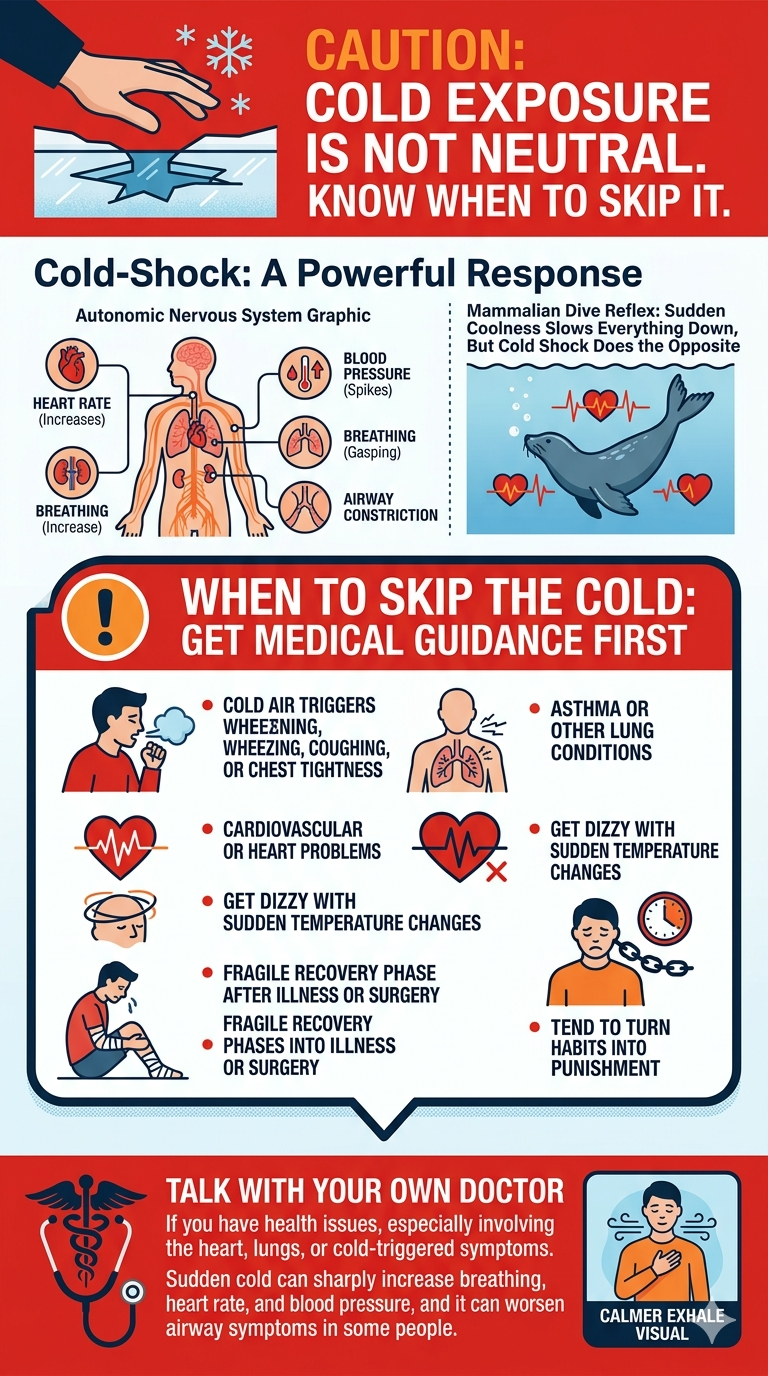
Cold is not neutral.
Skip it, or at least pause and get medical guidance first, if:
- cold air already triggers wheezing, coughing, or chest tightness
- you have asthma or another lung condition that reacts badly to cold
- you have cardiovascular disease or a history of heart problems
- you get dizzy with sudden temperature changes
- you are in a fragile recovery phase after illness or surgery
- you tend to turn every habit into punishment instead of support
If you have health issues, especially involving the heart, lungs, or cold-triggered symptoms, talk with your own doctor before making deliberate cold exposure a regular habit. Sudden cold can sharply increase breathing, heart rate, and blood pressure, and it can worsen airway symptoms in some people.
FAQ
Are cold showers actually healthy?
They can be, for some people, in the right dose. The likely benefits are more about alertness, routine, and stress adaptation than miracle healing. The risks matter too, especially for people with breathing or heart issues.
Do cold showers help anxiety?
Some people find them grounding because the cold interrupts mental spirals and forces attention into the body. That said, they can also feel too intense for some nervous systems. The research on stress and wellbeing is promising but still mixed.
Can cold showers improve breathing?
They can improve your awareness of how you breathe under stress, which is different from saying they improve lung function directly. The skill is often in recovering from the first gasp, not in the cold itself.
Are cold showers bad for asthma?
They can be a problem for some people. Cold air and cold exposure can irritate airways and worsen symptoms such as wheezing, cough, and breathlessness.
Do cold showers activate brown fat?
Cold exposure can activate brown adipose tissue in humans, but that is not the same as proving major everyday metabolic benefits from short showers. The current human evidence is interesting but still modest.
Final Verdict
If you are curious about cold shower benefits, the most honest answer is this: they may help with energy, alertness, resilience, recovery, and breathing awareness, but they are not a cure-all. Used well, cold can become a small daily practice in staying steady when the body wants to tense up and rush. Used badly, it just becomes another thing to push through. And if you have heart, lung, or other health concerns, it is smarter to speak with your own doctor before making it a regular habit.
References
- Cain et al., 2025. Effects of cold-water immersion on health and wellbeing: A systematic review and meta-analysis.
- Tabei et al., 2024. Metabolic Effects of Brown Adipose Tissue Activity Due to Cold Exposure in Humans: A Systematic Review and Meta-Analysis.
- Asthma + Lung UK. Cold weather and your lungs.
- Wim Hof Method. Breathing Exercises, The Art of Cold Dipping, and Terms & Conditions.
About The Author
