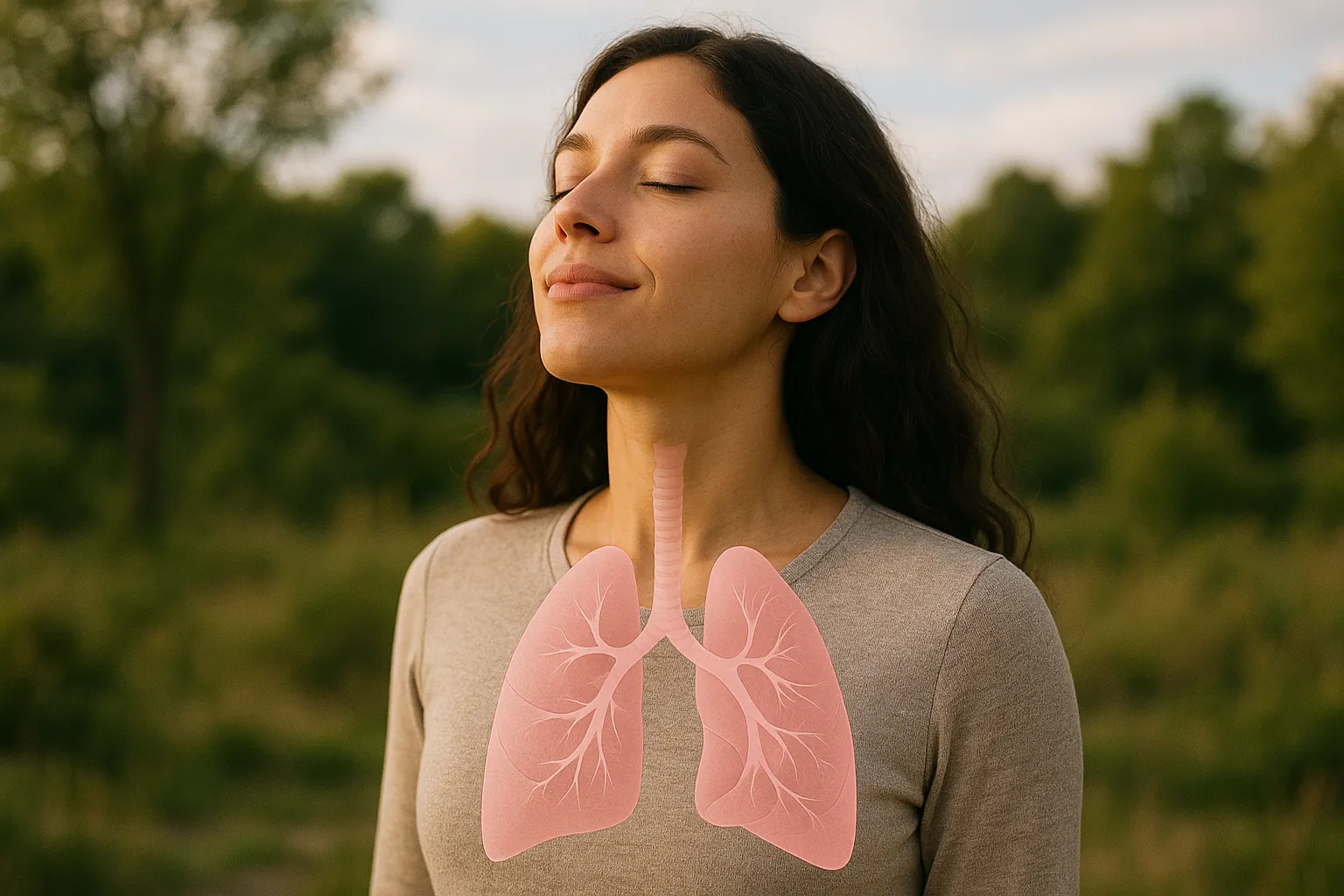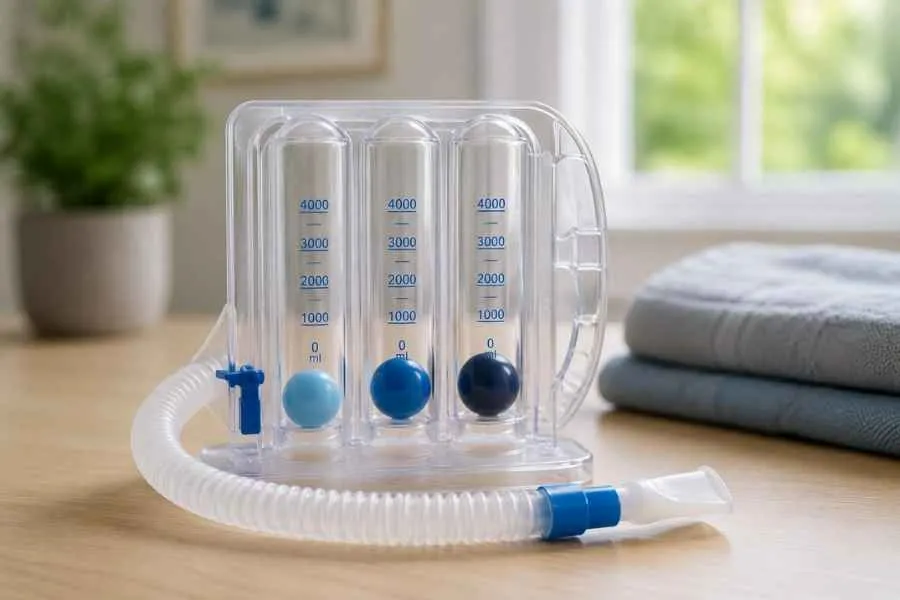
Incentive Spirometry Guide: How to Use an Incentive Spirometer After Surgery
Quick Answer
An incentive spirometer is a simple breathing device often used after surgery to help you take slow, deep breaths and keep your lungs more active during recovery.
It is commonly used after chest, lung, heart or abdominal surgery because pain, anesthesia and lying still can make people breathe more shallowly. Shallow breathing can make it harder for the small air sacs in the lungs to fully expand.
For most adults recovering after surgery, the best choice is usually a clearly labeled adult volumetric incentive spirometer, such as a Voldyne 5000-style device or a comparable adult 5000 mL volumetric incentive spirometer from a reputable medical supply brand.
The key is precision. Do not confuse a true incentive spirometer with vague “breathing trainer” products. A proper incentive spirometer should be clearly labeled as an incentive spirometer or volumetric exerciser, have visible volume markings, include a mouthpiece, and be intended for post-surgery breathing practice.
If you have just had lung surgery, always follow your hospital discharge instructions first.
Medical Note
This guide is for educational purposes only and is not medical advice. If your surgeon, respiratory therapist, pulmonologist or nurse gave you a specific breathing plan, follow that plan.
Stop and contact your care team if breathing exercises cause severe shortness of breath, chest pain, dizziness, fainting, coughing blood, a sudden drop in oxygen levels, fever or symptoms that feel worse instead of gradually easier.
Anita’s Take
After surgery, breathing can feel emotional as well as physical.
You may know that deep breathing is important, but when your chest, ribs or incision area hurts, your body naturally wants to protect itself. That can lead to shallow breathing, tension and fear of taking a full breath.
That is where an incentive spirometer can be useful. It gives you something visual and simple to focus on. You inhale slowly, watch the marker rise, hold the breath briefly if comfortable, and then rest.
It is not a magic device. It does not replace walking, coughing when instructed, pain control, clean air or proper medical follow-up. But used correctly, it can become part of a calm recovery routine that helps you reconnect with your breath one small session at a time.
What Is an Incentive Spirometer?
An incentive spirometer is a handheld breathing exercise device that encourages slow, deep inhalation.
Most basic models have:
- A mouthpiece
- A tube
- A clear chamber with volume markings
- A piston or ball that rises when you breathe in
- A goal marker to help you track progress
- A flow indicator that helps you avoid breathing in too fast
The word “incentive” matters. The device gives you visual feedback so you can see whether your inhale is slow, controlled and deep enough.
It is not the same as a full medical pulmonary function test. It is not a diagnosis tool. It is a home or hospital breathing exercise tool.
Incentive Spirometer Benefits
An incentive spirometer may help after surgery by encouraging:
- Slower, deeper breaths
- Better lung expansion
- More awareness of shallow breathing
- A more structured breathing routine
- Gentle movement of air into the lower lungs
- Coughing and mucus clearing when paired with your care team’s instructions
After surgery, many people breathe less deeply because of pain, fatigue, anesthesia or fear of coughing. An incentive spirometer gives you a gentle target and makes the exercise easier to repeat.
The most important point is this: it works best as part of a bigger recovery plan.
That plan may include walking, sitting upright, coughing or huff coughing when instructed, pain management, hydration, clean indoor air and medical follow-up.
For mucus support after surgery, read our guide on how to clear phlegm from your lungs after surgery.
Struggling with mucus after surgery? Learn practical ways to clear phlegm from your lungs after surgery.
Top Picks: Best Incentive Spirometer and Lung Breathing Tools
| Pick | Best for | What to look for | Main caution |
| Best overall | Voldyne 5000-style adult volumetric incentive spirometer | Clearly labeled incentive spirometer, adult use, volume markings, flow window | Avoid vague “breathing trainer” listings |
| Best simple alternative | Adult volumetric incentive spirometer from a reputable medical supply brand | 5000 mL adult capacity if appropriate, clear chamber, mouthpiece, tubing | Confirm it is not pediatric unless needed |
| Best visual beginner tool | 3-ball breathing exerciser | Clear visual feedback, simple design | Less precise than a marked volumetric model |
| Best for asthma-style tracking | Peak flow meter | Measures how fast you blow air out | Not the same as an incentive spirometer |
| Best digital tracking option | Digital FEV1 / PEF home spirometer | App or screen, repeatable readings, reputable brand | Should be interpreted with medical guidance |
| Related tool | Pulse oximeter | Spot checks oxygen saturation and pulse | Does not measure lung capacity or train breathing |
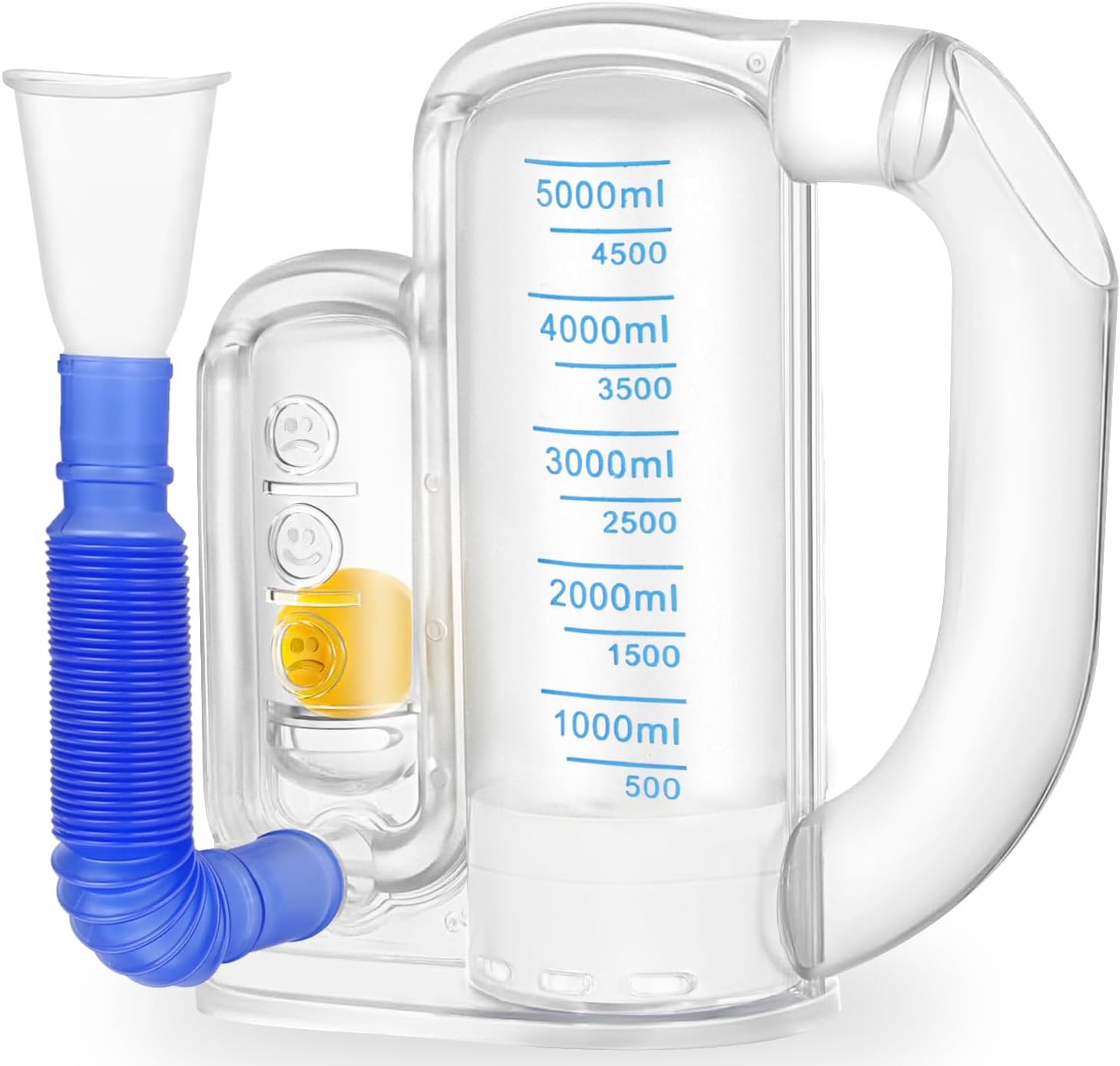
Best Overall: Voldyne 5000-Style Adult Volumetric Incentive Spirometer
For most adults recovering after surgery, the best first choice is a clearly labeled adult volumetric incentive spirometer.
The Voldyne 5000 is one of the best-known examples of this type of device. It is often used as a reference point because it has a clear chamber, volume markings and a visual flow window.
The important part is not only the brand name. The important part is that the product is truly an incentive spirometer or volumetric exerciser, not a vague breathing gadget.
Best for
- Post-surgery breathing exercises
- Lung surgery recovery routines
- Chest or abdominal surgery recovery
- People who want a simple, low-cost tool
- Anyone who was specifically told to use an incentive spirometer
What I like
It is simple, visual and easy to understand.
You do not need an app, subscription or complicated setup. You sit upright, seal your lips around the mouthpiece, inhale slowly, hold briefly if comfortable, breathe out and repeat according to your care team’s instructions.
Weakness
A basic incentive spirometer does not diagnose lung disease, measure oxygen levels or replace a pulmonary function test.
Who should avoid it
Avoid using one without medical guidance if you have unexplained chest pain, severe breathing symptoms, recent lung complications or if your care team has told you not to do forced breathing exercises.
Check the latest price on Amazon
Cleaner indoor air may support recovery. Explore our guide to air purifiers for post-lobectomy lung recovery.
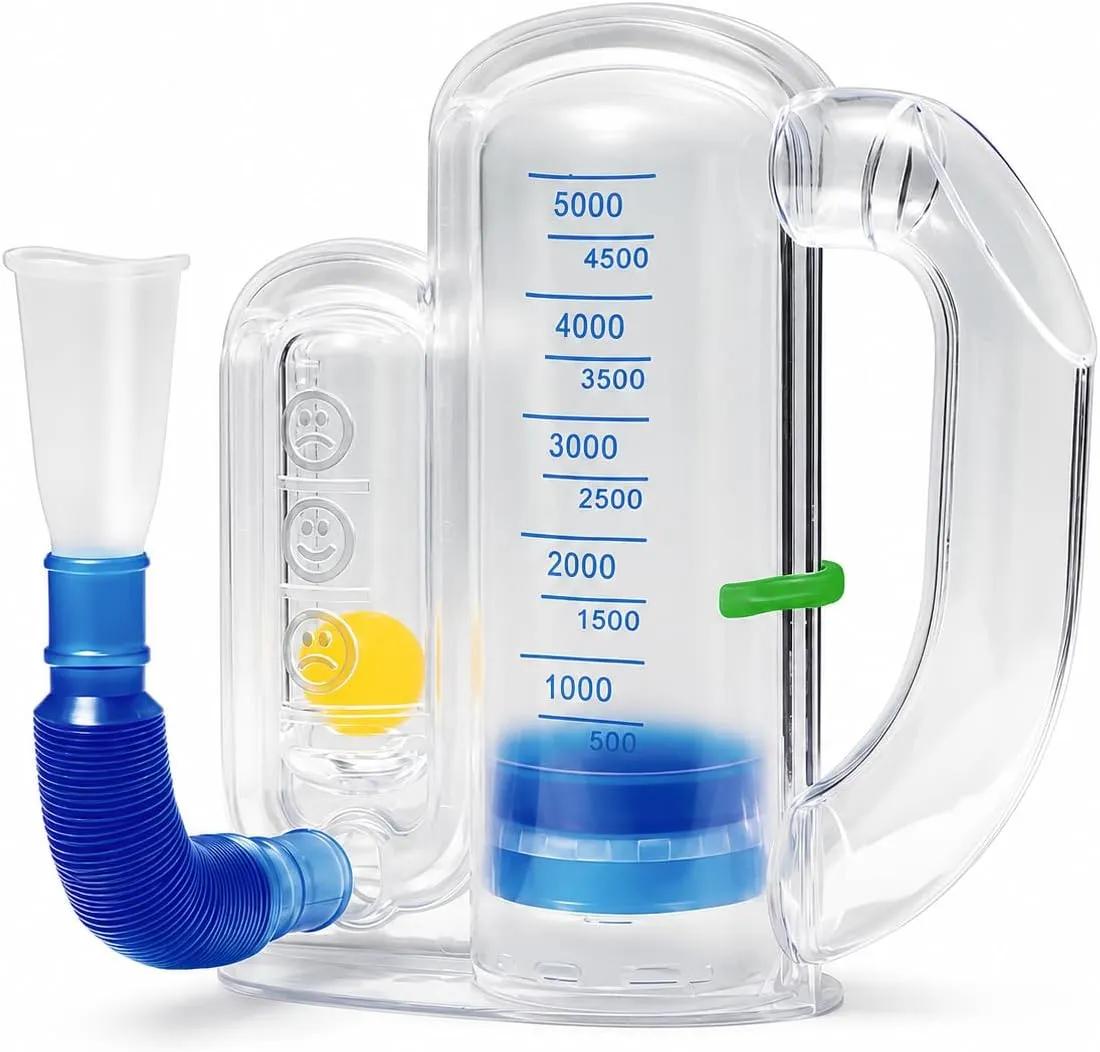
Best Simple Alternative: Adult Volumetric Incentive Spirometer
If the exact Voldyne 5000 is unavailable or the Amazon listing looks questionable, a comparable adult volumetric incentive spirometer from a reputable medical supply seller can still be a good choice.
Look for clear product language such as:
- Incentive spirometer
- Volumetric exerciser
- Adult use
- 5000 mL capacity, where appropriate
- Volume markings
- Mouthpiece included
- Flow indicator or flow window
- Single-patient use if stated
Avoid listings that only say “lung trainer,” “breathing trainer,” “respiratory trainer” or “lung capacity exerciser” without clearly identifying the product as an incentive spirometer.
Best for
- Adults who need a basic post-surgery breathing device
- Buyers who cannot find a trustworthy Voldyne listing
- People who want a practical medical-style tool without extra features
What I like
A simple adult volumetric model can do the job without unnecessary complexity.
Weakness
Generic listings vary in quality, labeling and included parts.
Who should avoid it
Avoid unclear listings that do not show the chamber, markings, mouthpiece or intended use.
Check the latest price on Amazon
Want to track your breathing progress? Learn about a lung device for measuring respiratory performance.
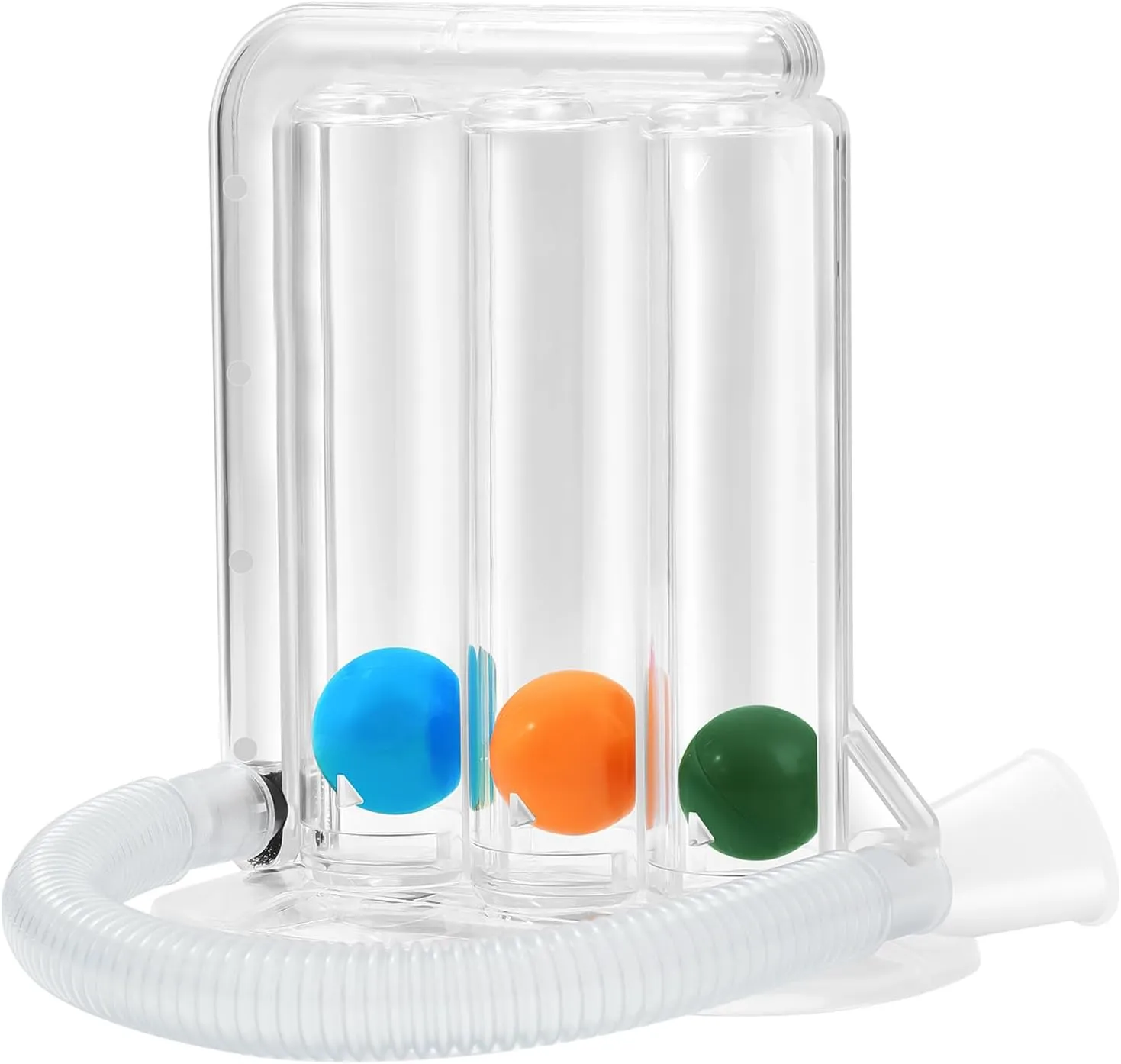
Best Budget Visual Option: 3-Ball Breathing Exerciser
A 3-ball breathing exerciser can be useful for people who like a simple visual cue.
Instead of a marked piston chamber, it usually uses three balls that rise as you inhale. Some people find this motivating because they can see the balls move immediately.
Best for
- Simple breathing practice
- Visual motivation
- Beginners who want something easy to understand
- Non-medical breathing awareness routines
What I like
It is easy to use and visually intuitive.
Weakness
It may not give the same clear volume measurement as a marked volumetric incentive spirometer.
Who should avoid it
If your hospital specifically told you to use a volumetric incentive spirometer after surgery, do not replace it with a 3-ball exerciser unless your care team says it is acceptable.
Check the latest price on Amazon
Best for Tracking: Peak Flow Meter
A peak flow meter is not an incentive spirometer, but it is often searched together with lung capacity tools.
A peak flow meter measures how fast you can blow air out. It is commonly used by people with asthma or airway conditions who have been told to monitor their peak expiratory flow.
Best for
- Asthma monitoring
- Tracking airway changes over time
- People whose doctor has recommended peak flow monitoring
- Home symptom tracking
What I like
It is small, affordable and easy to repeat daily.
Weakness
It does not train slow inhalation the way an incentive spirometer does. It measures forceful exhalation, not post-surgery lung expansion practice.
Who should avoid it
Do not use a peak flow meter as your main post-surgery breathing tool unless your care team specifically recommends it.
Check the latest price on Amazon
New to breathing exercises? Start with these guided breathing techniques for beginners.
Best Digital Option: FEV1 / PEF Home Spirometer
A digital spirometer or smart breathing monitor may track values such as peak flow and sometimes FEV1.
This can be useful for data-focused users, but it is more advanced than a basic incentive spirometer.
Best for
- People who want digital tracking
- Long-term lung function monitoring with medical guidance
- Asthma or COPD tracking when recommended by a clinician
- People who like app-based health data
What I like
It may give more detailed numbers than a basic peak flow meter.
Weakness
It costs more, can be confusing without context and may create anxiety if the user overchecks numbers without knowing what they mean.
Who should avoid it
Avoid this type if you are already anxious about health data or if you do not have a clinician helping you interpret the results.
Check the latest price on Amazon
Incentive Spirometer vs Lung Capacity Tester
This is an important distinction.
An incentive spirometer is mainly a breathing exercise tool. It helps you practice slow, deep inhalation.
A lung capacity tester or digital spirometer may measure certain breathing values, but home tools are not the same as a full pulmonary function test done in a clinic.
If your goal is surgery recovery, start with the tool your hospital recommends.
If your goal is monitoring asthma, COPD or long-term lung function trends, ask your doctor whether a peak flow meter or digital spirometer makes sense.
Simple daily habits can make a difference. Explore these breathing techniques for respiratory health.
How to Use an Incentive Spirometer
Your own discharge instructions come first. But the basic method usually looks like this:
- Sit upright in a chair or at the edge of the bed.
- Hold the incentive spirometer upright.
- Exhale normally first.
- Place the mouthpiece in your mouth and seal your lips around it.
- Inhale slowly and deeply through the mouthpiece.
- Keep the flow steady rather than fast and forced.
- Watch the marker or piston rise.
- Hold your breath for a few seconds if you can do so comfortably.
- Remove the mouthpiece and breathe out normally.
- Rest for a few normal breaths.
- Repeat as instructed by your care team.
- Cough gently if your nurse, respiratory therapist or surgeon told you to cough after a set.
Many hospital instructions use a routine such as 10 breaths every hour while awake after surgery. Some instructions may say 10 to 15 breaths every 1 to 2 hours, or another schedule. Your own plan may be different depending on your operation, pain level and lung health.
Curious about respiratory supplements? Discover the potential NAC supplement benefits for lung health.
How Often Should You Use It?
A common post-surgery instruction is often:
10 slow breaths every hour while awake.
But this is not universal. Some people are told to use it more or less often. Some are told to combine it with coughing, walking or other airway clearance methods.
The best routine is the one your care team gave you.
If you are at home and unsure how often to use it, call your hospital, nurse line or surgeon’s office instead of guessing.
What Number Should You Reach?
The number on the spirometer is not a competition.
Your goal should be realistic, safe and based on your body, surgery and recovery stage.
After surgery, it may feel frustrating if the number is lower than expected. That does not automatically mean something is wrong. Pain, fatigue, swelling, fear and shallow breathing can all affect the number.
A good goal is usually:
- Slow control
- Comfortable depth
- Steady repetition
- Gradual progress
- No sharp pain or panic
If your numbers suddenly drop, or breathing becomes much harder, contact your care team.
Common Mistakes to Avoid
Mistake 1: Buying the wrong product
This is one of the biggest mistakes.
Many Amazon listings use words like “breathing trainer,” “lung exerciser,” “respiratory trainer” or “lung capacity device.” Some may be useful for other purposes, but they are not always true incentive spirometers.
For post-surgery breathing practice, look for a product clearly labeled as an incentive spirometer or volumetric exerciser.
Mistake 2: Breathing in too fast
The goal is not to suck air in as quickly as possible. A slower inhale is usually better because it encourages controlled lung expansion.
Mistake 3: Slouching
Posture matters. Sitting upright gives your lungs more room to move.
If posture feels difficult, read our guide on posture and breathing.
Mistake 4: Skipping it because it feels uncomfortable
Some discomfort can happen after surgery, especially around the ribs, chest or abdomen. But sharp pain, severe breathlessness or dizziness should not be ignored.
Use pillows or incision support if your hospital taught you to do that.
Mistake 5: Using it instead of walking
An incentive spirometer is not a replacement for early mobility when walking has been cleared by your care team.
Walking helps circulation, airway movement and confidence.
Mistake 6: Treating the number like a diagnosis
The number is feedback, not a full medical evaluation.
Do not use a home incentive spirometer to self-diagnose lung capacity, pneumonia, atelectasis or surgical complications.
When an Incentive Spirometer Genuinely Helps
This tool makes the most sense when:
- You have been told to use it after surgery
- You are breathing shallowly because of pain or fear
- You need a structured reminder to take deeper breaths
- You want visual feedback during recovery
- You are trying to rebuild confidence after chest or abdominal surgery
In a post-lobectomy or lung surgery recovery setup, it may be one part of a larger routine that also includes clean air, gentle walking, pain control, hydration and mucus clearance.
For home air support, see our guide to air purifiers for post-lobectomy lung recovery.
When You May Not Need One
You may not need to buy an incentive spirometer if:
- Your hospital already gave you one
- Your care team told you not to use one
- You are looking for asthma monitoring instead
- You want oxygen monitoring instead
- You want a true clinical lung function test
- You are fully recovered and only want general breath training
For general breathing training, a breathing trainer, diaphragmatic breathing routine or guided breathing practice may be more appropriate.
Where to Buy an Incentive Spirometer
You can usually buy an incentive spirometer from:
- Amazon
- Online medical supply stores
- Some pharmacies
- Hospital discharge supply shops
- Respiratory care suppliers
Before buying, check:
- Is it clearly labeled as an incentive spirometer or volumetric exerciser?
- Is it intended for adult use if you are an adult?
- Does it have clear volume markings?
- Does it include a mouthpiece and tubing if needed?
- Is it sealed and hygienic?
- Is it easy to store cleanly between uses?
- Does the listing clearly describe it as an incentive spirometer, not a different breathing trainer?
- Are there enough recent reviews to judge quality and usability?
- Is the seller reputable?
- Is the product new and not used?
Avoid vague listings that use many confusing terms without clearly explaining what the device measures or how it is intended to be used.
What to Look for Before Buying
Clear product identity
The listing should clearly say incentive spirometer or volumetric exerciser.
Adult capacity if needed
For most adults, look for an adult model. Voldyne 5000-style models are commonly associated with adult volumetric breathing practice.
Clear markings
A good incentive spirometer should be easy to read.
Stable base
You do not want it tipping over while you are recovering.
Comfortable mouthpiece
A mouthpiece that feels awkward makes people less likely to use the device consistently.
Flow indicator
A flow indicator helps you avoid inhaling too fast.
Clean packaging
A breathing device should be new, hygienic and suitable for single-patient use if stated.
No exaggerated claims
Avoid products that promise to cure lung disease, dramatically increase lung capacity overnight or replace medical rehabilitation.
Incentive Spirometer vs Breathing Trainer
An incentive spirometer is usually used for slow, deep breathing after surgery.
A breathing trainer may be used for respiratory muscle training, athletic performance or general breathwork.
They are not always interchangeable.
If you are recovering from surgery, do not swap devices without asking your care team.
Incentive Spirometer vs Pulse Oximeter
A pulse oximeter measures oxygen saturation and pulse.
An incentive spirometer helps you practice deep inhalation.
They answer different questions.
A pulse oximeter can tell you something about oxygen levels at that moment. It does not train your lungs.
An incentive spirometer can help you practice breathing mechanics. It does not tell you your oxygen saturation.
Some people recovering from lung surgery may use both, but only if this does not create anxiety or replace medical advice.
Incentive Spirometer vs Nebulizer
A nebulizer delivers misted medication or saline into the airways when prescribed or recommended.
An incentive spirometer does not deliver medication. It is a breathing exercise tool.
If you have mucus, wheezing or airway symptoms, ask your clinician what belongs in your plan. Some people need airway clearance, medication, hydration, humidification or medical assessment, not just breathing exercises.
Safety Tips After Lung or Chest Surgery
- Sit upright when using the device.
- Move slowly and do not force the breath.
- Support your incision if instructed.
- Use pain medication as prescribed so you can breathe and cough effectively.
- Do not chase high numbers.
- Rest between breaths.
- Keep the mouthpiece clean and covered between uses.
- Walk only as cleared by your medical team.
- Call your care team if symptoms worsen.
- Use the spirometer as one part of recovery, not the whole plan.
My Honest Verdict
An incentive spirometer is worth having if your hospital or care team recommends it after surgery.
It is simple, usually affordable and easy to use. The biggest benefit is not that it “fixes” your lungs by itself. The benefit is that it gives you a structured way to practice slow, deep breathing when your body may naturally want to stay guarded and shallow.
The best choice for most post-surgery users is a clearly labeled adult volumetric incentive spirometer, ideally a Voldyne 5000-style device or a comparable adult volumetric model from a reputable medical seller.
If you want tracking, consider a peak flow meter or digital FEV1 / PEF spirometer, but understand that those are different tools.
For recovery, simple and consistent often beats complicated and expensive.
FAQ
What is an incentive spirometer used for?
An incentive spirometer is used to encourage slow, deep breathing, often after surgery. It helps remind you to expand your lungs more fully instead of breathing shallowly.
How do you use an incentive spirometer?
Sit upright, seal your lips around the mouthpiece, inhale slowly and deeply, hold briefly if comfortable, breathe out normally and rest. Repeat according to your medical instructions.
How often should I use an incentive spirometer after surgery?
Many hospitals recommend 10 breaths every hour while awake, but your own discharge instructions may be different. Follow your care team’s plan.
Can an incentive spirometer prevent pneumonia?
An incentive spirometer may be part of a routine intended to reduce postoperative lung complications, but it should not be treated as a guaranteed way to prevent pneumonia. It works best alongside walking, coughing when instructed, pain control and medical follow-up.
Is an incentive spirometer the same as a lung capacity tester?
No. A basic incentive spirometer is mainly a breathing exercise tool. A lung capacity test or pulmonary function test is a medical evaluation done with clinical equipment.
Where can I buy an incentive spirometer?
You can usually buy one from Amazon, online medical supply stores, some pharmacies or respiratory care suppliers. Choose a product that is clearly labeled as an incentive spirometer or volumetric exerciser.
What is the best incentive spirometer to buy?
For most adults after surgery, a Voldyne 5000-style adult volumetric incentive spirometer or a comparable adult volumetric model is the best starting point. Avoid vague “breathing trainer” listings that are not clearly identified as incentive spirometers.
Can I use an incentive spirometer if I had a lobectomy?
Many people are given breathing exercises after lung surgery, but you should follow your surgeon’s or respiratory therapist’s instructions. If you had a lobectomy, do not create your own aggressive breathing routine without medical guidance.
Can using an incentive spirometer hurt?
It may feel uncomfortable after surgery, but it should not cause severe pain, dizziness, fainting or worsening shortness of breath. Stop and contact your care team if symptoms feel concerning.
Should I buy a peak flow meter instead?
A peak flow meter is different. It measures how fast you can blow air out and is often used for asthma monitoring. It does not replace an incentive spirometer for post-surgery inhalation practice unless your clinician tells you otherwise.