For straightforward ventilation checks, choose Aranet4 HOME. If you also want radon and particle measurements, Airthings View Plus gives you a broader picture, while AirGradient ONE suits a fixed room where you want several air-quality readings.
A useful CO2 monitor or air quality monitor measures carbon dioxide directly and makes daily patterns in indoor air quality easy to understand. You don’t need to watch every fluctuation. Start with the device that answers your main question: does this room need more fresh air, or are there other pollutants to understand too?
CO2 monitors at a glance
A CO2 monitor is a good fit for ventilation checks; an air quality monitor offers broader indoor air quality readings, including PM2.5.
| Product | Best for | Main trade-off |
|---|---|---|
| Aranet4 HOME | Portable ventilation checks at home or work | Premium-priced, without particle or radon sensing |
| Airthings View Plus | Broader home air-quality monitoring, including CO2, PM2.5 and radon | More expensive and complex than a CO2-only monitor |
| AirGradient ONE | A permanent multi-sensor setup for a home office | Needs continuous power rather than batteries |
| Qingping CO2 & Temp & RH Monitor | Budget-friendly NDIR CO2 monitoring for bedrooms or home offices | No PM2.5 or radon sensing |
A dedicated monitor is enough if ventilation is your main concern. A multi-sensor unit earns its place when you’ll also act on particle or humidity readings.
Neither type cleans the air. An air purifier doesn’t remove CO2, so your monitor helps you decide whether source reduction or filtration needs attention.
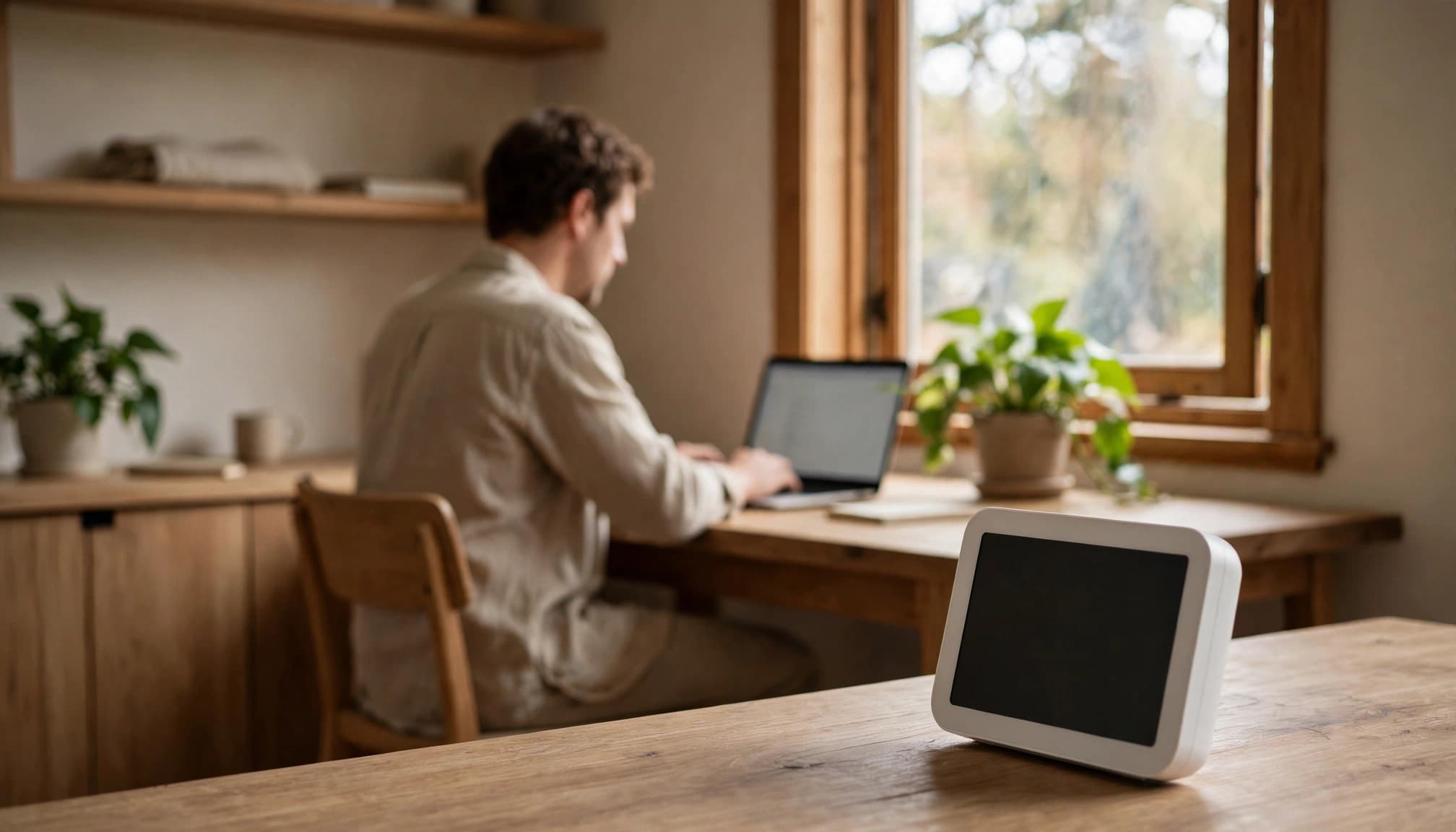
Three CO2 monitors worth choosing
Aranet4 HOME: Best CO2 Monitor Overal
Choose Aranet4 HOME when you want clear readings without another plugged-in device. This CO2 monitor uses an NDIR CO2 sensor to measure carbon dioxide directly, and its e-ink display shows readings with traffic-light indicators.
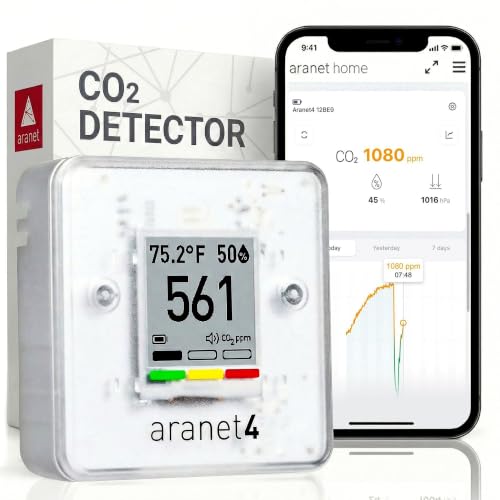
Bluetooth connects the Aranet4 to the Aranet Home app for trends. It uses two AA batteries, with manufacturer-rated battery life up to four years, depending on settings. Published CO2 accuracy is ±(30 ppm + 3% of the reading).
The premium price buys portability and simplicity. Skip it if particles are your main concern.
Airthings View Plus: Best CO2 Monitor for Whole-Home Air Quality
Choose View Plus if you want one premium monitor for CO2, radon, VOC, humidity, temperature and air pressure. Wi-Fi makes it useful for tracking changes beyond the room you’re sitting in.

Its main advantage is context: a closed bedroom can accumulate CO2, while cooking can raise particles for a different reason. Our guide to reading indoor PM2.5 levels helps you interpret that separate measurement.
The trade-off is complexity. Skip View Plus if you only need an occasional ventilation check.
AirGradient ONE: Best CO2 Monitor for a Home Office
Choose AirGradient ONE if you want direct CO2 sensing alongside particle, temperature, humidity and VOC/NOx readings. Its Wi-Fi connection suits ongoing monitoring in a home office or main living area.
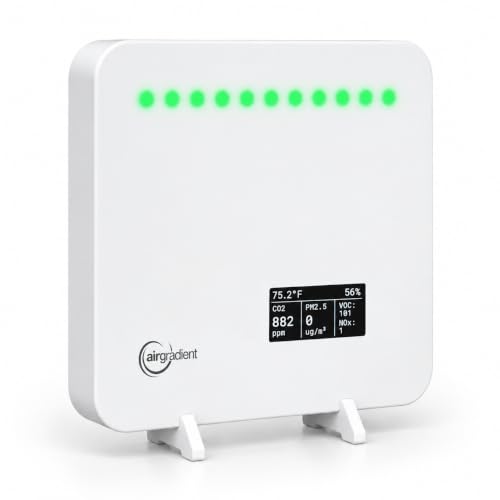
This mid-range option gives you broader coverage than a dedicated CO2 meter. The practical compromise is continuous power: it works better on a permanent shelf than in a bag.
Skip it if you want battery-powered room-to-room checks or built-in radon measurement.
Choose AirGradient ONE for a consistent view of one occupied room.
Qingping CO2 & Temp & RH Monitor: Best Budget CO2 Monitor
Choose the Qingping CO2 & Temp & RH Monitor if you want an affordable way to check ventilation in your bedroom or home office. It uses a genuine Sensirion NDIR sensor to measure CO2 directly, rather than estimating it from other gases. It also tracks temperature and humidity, helping you understand everyday indoor conditions.

The main trade-off is fewer features. It doesn’t measure PM2.5 or radon, but it’s a practical budget choice for monitoring CO2 levels and identifying when a room needs more fresh air.
How we chose these monitors
These recommendations prioritize direct CO2 measurement, established manufacturers, published specifications and calibration guidance. Each CO2 meter suits a different routine: portable checks, broader home monitoring or a permanent room setup.
Direct sensing comes before extra features
NDIR means nondispersive infrared. A CO2 sensor using this method measures how much infrared light carbon dioxide absorbs at a particular wavelength. It’s a well-established approach for indoor measurement. The Aranet4 HOME is one example of a device that uses NDIR.
Photoacoustic sensors can also measure CO2 directly. The distinction that matters most is measured CO2 versus estimated CO2, rather than one acronym alone.
An eCO2 device estimates CO2 from another signal, often a metal-oxide VOC sensor. Perfume, cleaning products or even peeling fruit can influence that signal. For buying decisions focused on ventilation, choose direct measurement.
Read the full accuracy specification, too. A display that shows individual ppm values doesn’t mean the device measures accurately to that degree.
Other good options
Airthings Wave Plus suits you if radon and CO2 matter but particle measurements don’t. Airthings View Plus earns the main recommendation because it adds PM2.5 sensing, which gives useful context when you assess ventilation.
IQAir AirVisual Pro is another established choice for CO2 and particle monitoring. It stays outside this shortlist because View Plus adds radon coverage.
If radon is also a concern, a dedicated radon monitor or Airthings View Plus covers it; a CO2 reading can’t.
For an Airthings radon monitor, allow at least 30 days, ideally longer, to build a representative average. A first-day reading isn’t your home’s long-term picture.
What indoor CO2 readings mean
Carbon dioxide rises when people exhale into a room faster than ventilation removes it. A CO2 meter helps you spot that imbalance before judging the room by feel.
Use these bands as ventilation prompts
These CO2 levels are practical prompts, not medical safety categories.
| CO2 reading (ppm) | Practical interpretation |
|---|---|
| 400 to below 600 | Excellent dilution, close to outdoor conditions |
| 600 to below 800 | Generally good ventilation |
| 800 to below 1,000 | Approaching a useful ventilation prompt |
| 1,000 to below 1,500 | Poorer ventilation relative to occupancy |
| 1,500 to below 2,500 | Substantial buildup; improve ventilation |
| 2,500 or higher | Very poor dilution; address promptly |
Use 1,000 ppm as a practical point to consider bringing in more fresh air. Outdoor carbon dioxide concentration, occupancy and building use all affect interpretation.
ASHRAE’s indoor CO2 guidance explains how carbon dioxide can inform ventilation decisions without describing every aspect of indoor air quality.
How CO2 Affects Sleep and Focus
Higher CO2 is a sign that a room isn’t getting enough fresh air, and it can affect how you feel. In a 2015 Harvard study of office workers, decision-making scores were about 15% lower at around 945 ppm and 50% lower at around 1,400 ppm, compared with well-ventilated conditions. A closed bedroom can easily pass 1,000 ppm overnight, which is why many people use a CO2 monitor to check their sleeping space.
A low CO2 reading gives only a partial picture of indoor air quality. It can’t replace separate measurements for PM2.5, VOCs, radon or carbon monoxide.
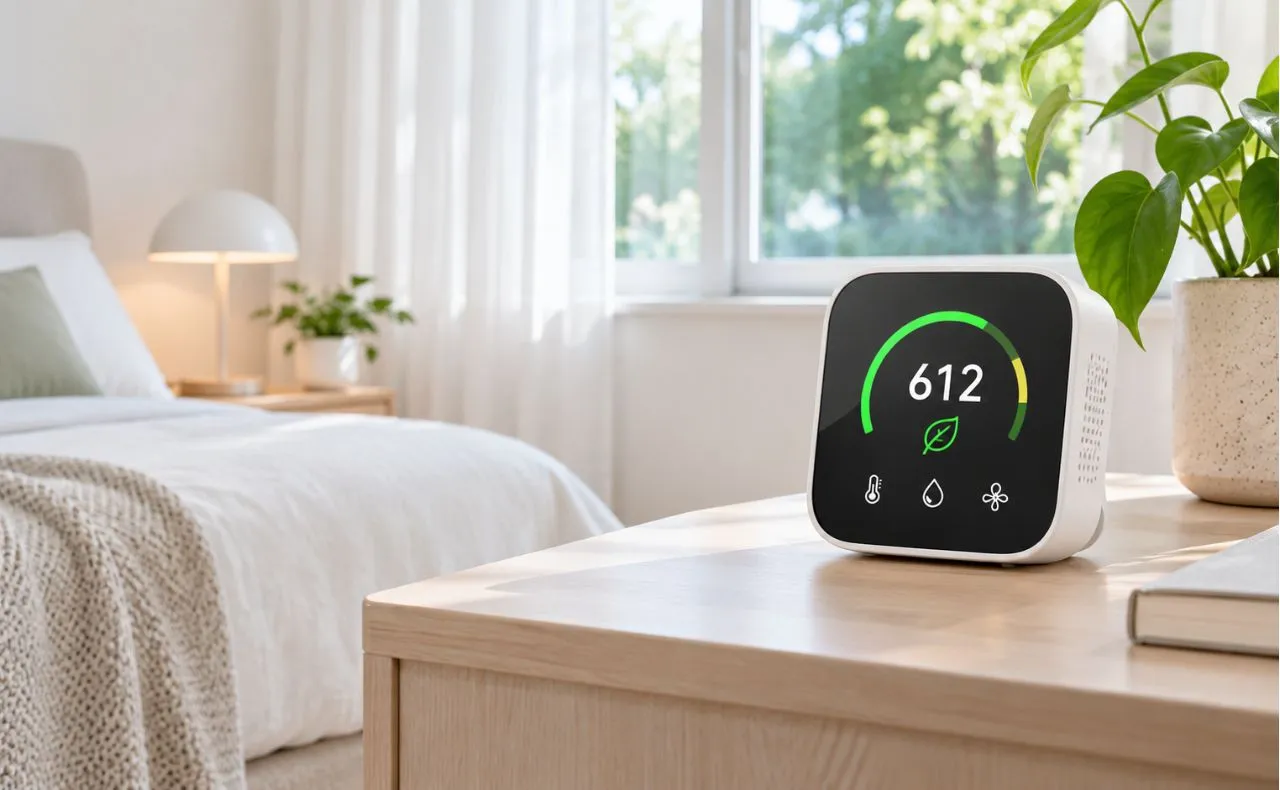
A green CO2 display can suggest good dilution of exhaled air while missing a separate particle or gas problem.
Your device measures the room, not lung function, oxygen levels or the cause of symptoms. Talk to your doctor about persistent breathing symptoms rather than interpreting them through an air-quality display.
Place your monitor and respond to trends
A useful reading reflects the air where you spend time. Placement and consistency matter more than watching the display constantly.
Give it a representative position
Place the monitor around breathing height, roughly 3 to 5 feet (0.9 to 1.5 meter) above the floor. Keep it at least 3 feet (about 1 metre) from windows, doors, and air vents, and away from your face.
Leave its air openings clear. Follow its calibration instructions, including any warm-up period. Don’t repeatedly recalibrate just because you dislike a reading.
For a bedroom, leave it in one location overnight. Notice whether readings rise with the door closed and fall after morning ventilation.
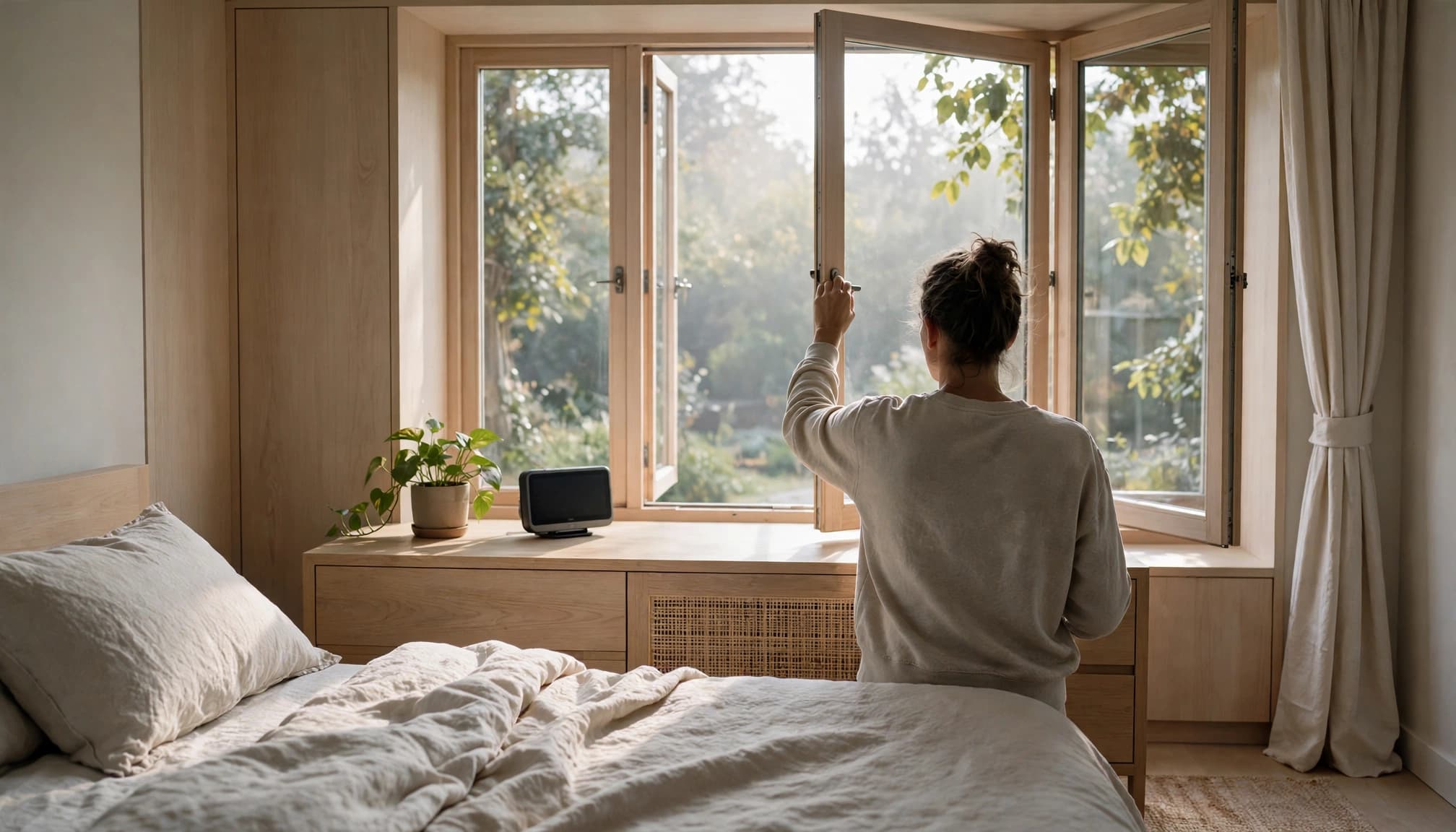
Make one change, then watch the trend
When CO2 levels stay elevated, open windows on opposite sides where practical and outdoor conditions allow. This can bring in fresh air.
Bathroom fans and kitchen hoods improve ventilation only when they exhaust outdoors. For recurring problems, an appropriately designed HRV or ERV system can provide controlled ventilation. In offices or classrooms, persistent increases can help whoever manages ventilation identify a problem.
An ordinary air purifier can help reduce particles such as PM2.5, but it doesn’t remove CO2 or replace fresh-air supply. For better results, see our guide to Air Purifier Placement for Better Room Coverage
During wildfire smoke, don’t open windows automatically in response to CO2. Our guidance on bedroom air during wildfire smoke explains the separate filtration and outdoor-air considerations.
Change one thing at a time, then compare sustained readings under similar conditions. A clear improvement over time tells you more than a small difference between adjacent measurements.

Common questions about CO2 monitors
What is a good CO2 level indoors?
Below 800 ppm is generally good. Above 1,000 ppm is a practical sign to bring in more fresh air, and above 1,500 ppm the room needs ventilation. Outdoor air is around 420 ppm
Where should I put a CO2 monitor?
In the room where you spend the most time, often the bedroom or home office, at breathing height and at least 3 feet from windows, doors, vents and your face.
What’s the difference between CO and CO2 monitors?
Carbon monoxide (CO) is a poisonous gas produced by incomplete combustion. A certified carbon monoxide alarm provides a separate safety function.
Carbon dioxide (CO2) is the gas you exhale. A CO2 reading shows how much carbon dioxide is in the air. A CO2 device doesn’t replace a certified carbon monoxide alarm, even if both products are described as gas detectors.
How many CO2 meters do you need at home?
Start with one portable meter if you want to understand patterns. Use it for several nights in the bedroom, then for several occupied workdays in your home office.
Add another when you need readings from separate rooms at the same time. One monitor in a hallway won’t reliably describe every closed bedroom.
Is a home monitor suitable for a commercial CO2 installation?
A consumer CO2 monitor isn’t a substitute for a code-compliant gas-safety system. Restaurants, breweries and other premises that use stored CO2 may need fixed detectors, audible and visual alarms, and correctly positioned sensors.
A professional should select these systems for the application and local requirements. Their purpose differs from checking whether a meeting room needs more ventilation.
Choose the monitor you’ll use consistently
Choose Aranet4 HOME for portable ventilation checks, Airthings View Plus for broader monitoring that includes radon, or AirGradient ONE for a fixed multi-sensor setup.
Start in the room where you spend the longest stretch. Keep placement consistent, notice the daily pattern, and make one manageable change.
The goal is useful information, not another number to worry about. A monitor earns its place when it helps you make a clearer decision about fresh air.