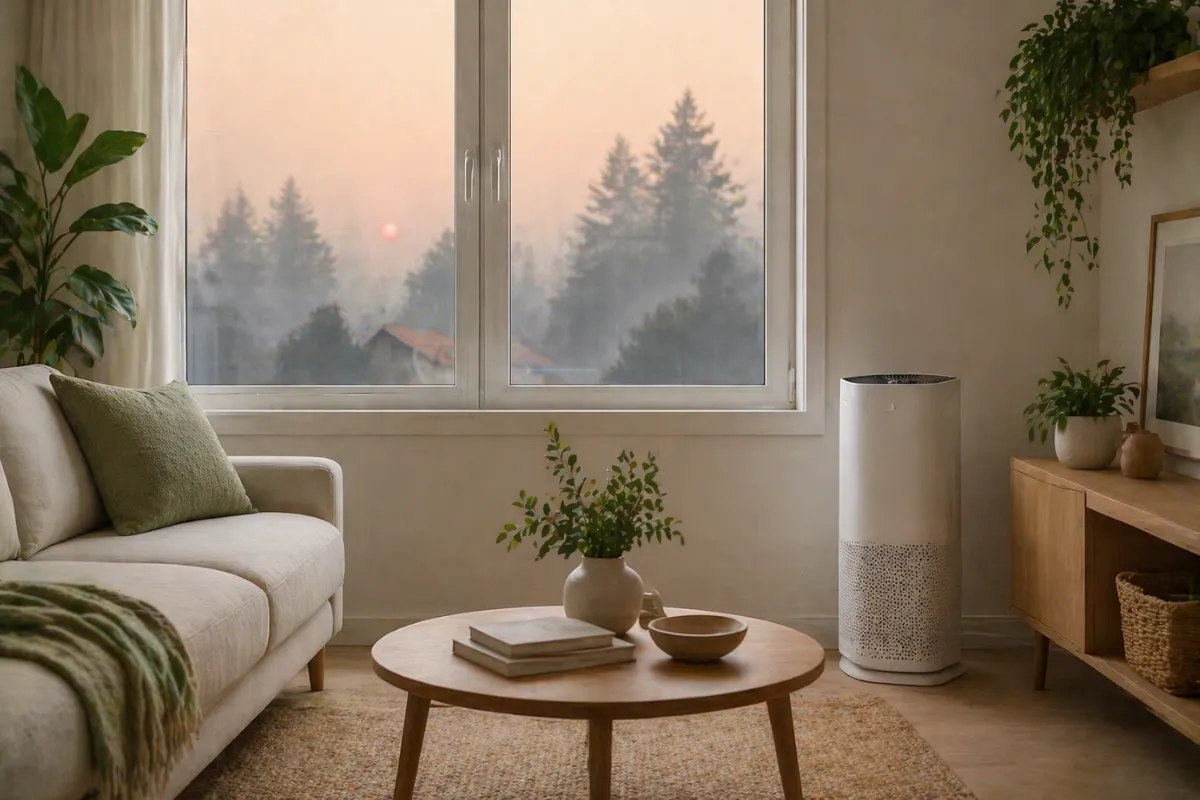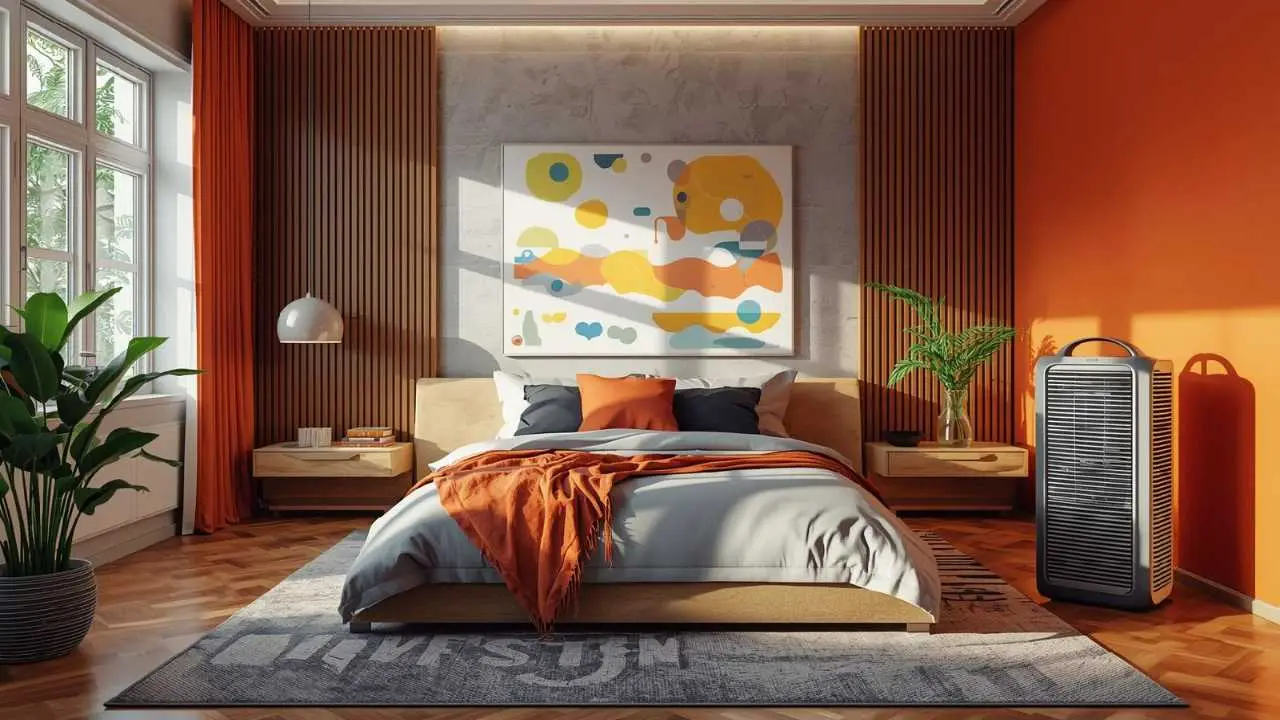
The best bedroom purifier is one you can leave running while you sleep. When comparing wildfire smoke air purifiers, prioritize smoke CADR, high airflow for your room, and a usable overnight fan setting.
Levoit Core 400S-P, Coway Airmega AP-1512HH Mighty, and Blueair Blue Pure 311i Max are worth considering, with different controls and filtration designs. None should be bought on a large room-coverage claim alone.
Start with these trade-offs, then match the purifier to your bedroom.
Looking for a broader comparison beyond the bedroom? See our wildfire smoke air purifier guide for whole-home and larger-room options.
Bedroom air purifiers worth considering
These three models take different approaches to bedroom use and may suit different needs if you’re choosing an air purifier for wildfire smoke. Check the exact model’s documented smoke CADR through AHAM’s certified air-cleaner directory where available, or request test documentation from the manufacturer.
Before buying, verify current model names, compatible filters, prices, stock, and test documentation. Check whether a replacement filter actually contains activated carbon, and compare its cost. Activated carbon filters shouldn’t be assumed to remove gases without documentation.
Levoit Core 400S-P: app controls and filter options
 LEVOIT Smart Air Purifiers for Home Large Room Up to 1733 Ft² Core 400S-P
A smart air purifier designed for medium-sized bedrooms and living spaces. It uses 3-stage filtration and includes PM2.5 monitoring, app controls, and Sleep Mode, making it a practical option for overnight use during wildfire smoke events.
Specifications:
- CADR: 231 CFM
- Recommended room size: 358 sq ft at 4.8 ACH
- Noise level: 22–52 dB
- Filtration: 3-stage filtration
- Controls: Touch controls + VeSync app
- Air quality monitoring: PM2.5 sensor and display
- Modes: Auto Mode, Sleep Mode
- Smart features: Wi-Fi and app control
- Optional filter: Smoke Remover Carbon Replacement Filter
- Best for: Smart controls and quiet bedroom use
The Core 400S family is worth considering if you want app controls and a compact tower design.
Levoit’s official listing reports $189.99 for the Core 400S purifier and $64.99 for its Core 400S Smoke Remover Carbon Replacement Filter. These are listed prices, not guaranteed checkout prices. Confirm the exact Core 400S-P model, compatible filter, and stock before ordering.
The drawback is ongoing filter cost. Also, the smoke-remover name doesn’t establish measured removal of wildfire gases. Choose it primarily based on documented particle-cleaning performance.
Coway Airmega AP-1512HH Mighty: straightforward controls
 Coway Airmega Mighty AP-1512HH
A compact air purifier with straightforward physical controls, a washable pre-filter, and HEPA particle filtration. Its strong smoke CADR and simple operation make it a solid choice for bedrooms where reliable continuous airflow matters more than smart-app features.
Specifications:
- Smoke CADR: 233 CFM
- Recommended room size: 361 sq ft at 4.8 ACH
- Noise level: 24–53 dB
- Filtration: Washable pre-filter, deodorization filter, HEPA filter
- Controls: Physical controls
- Modes: Auto Mode, Eco Mode
- Air quality sensor: Yes
- Ionizer/bipolar feature: Included and can be switched off
- Washable pre-filter: Yes
- Best for: Simple controls and dependable filtration
The Mighty is worth considering if you prefer physical controls and a washable prefilter rather than relying on an app. Its optional ionizer can be switched off if you prefer filter-only operation.
Its Eco mode can pause the fan when the sensor reads clean. During wildfire smoke, use a continuous manual setting instead.
Skip it if your room needs more airflow than its documented smoke performance supports. A familiar model name doesn’t replace checking the exact specifications.
Blueair Blue Pure 311i Max: fabric prefilter and connected controls
 Blueair Blue Pure 311i Max
A smart air purifier with higher smoke CADR, app controls, and Night Mode. It uses Blueair’s HEPASilent system, which combines mechanical and electrostatic filtration, and includes a washable fabric pre-filter for easier maintenance.
Specifications:
- Smoke CADR: 283 CFM
- Recommended room size: 439 sq ft at 4.8 ACH
- Noise level: 23–50 dB
- Filtration: HEPASilent mechanical + electrostatic filtration
- Main filter: Particle + Carbon filter
- Pre-filter: Washable fabric pre-filter
- Controls: Touch controls + Blueair app
- Modes: Auto Mode, Night Mode
- Air quality monitoring: Built-in particle sensor
- Smart features: Wi-Fi and app control
- Best for: Higher smoke CADR and overnight operation
The 311i Max combines app controls with a washable fabric prefilter, which can be useful in bedrooms with pets.
Its HEPASilent system combines mechanical and electrostatic filtration. Skip it if you want mechanical-only filtration.
The main buying caution is to compare airflow and noise at the same fan setting. A low advertised sound level doesn’t tell you how much smoke-filtered air it delivers overnight. Check replacement-filter pricing before committing, especially if smoke events are frequent.
Size wildfire smoke air purifiers by smoke CADR
CADR, or clean air delivery rate, describes how much filtered air a purifier supplies. For wildfire particles, compare the tobacco-smoke CADR, usually stated in cubic feet per minute.
Calculate your bedroom’s minimum
Multiply your room size’s length by its width to get floor area. The EPA’s smoke-CADR sizing rule, from the U.S. EPA, sets the minimum smoke CADR at two-thirds of that area for an 8-foot ceiling.
Here are four room sizes to compare.
| Bedroom dimensions | Floor area | Minimum smoke CADR | Higher-airflow target |
|---|---|---|---|
| 10 × 12 feet | 120 square feet | 80 cfm | 120 cfm |
| 12 × 15 feet | 180 square feet | 120 cfm | 180 cfm |
| 12 × 20 feet | 240 square feet | 160 cfm | 240 cfm |
| 15 × 20 feet | 300 square feet | 200 cfm | 300 cfm |
The higher target follows the more conservative AHAM recommendation cited by the EPA: smoke CADR equal to the room’s square footage.
Leave room for quieter operation
Published CADR generally reflects the highest fan setting. Meeting the minimum on maximum speed doesn’t mean the purifier meets it in sleep mode.
A larger unit with high airflow capacity can offer flexibility, but that doesn’t guarantee adequate performance on sleep mode. Check its lower-speed performance, too. For ceilings above 8 feet, choose higher CADR. The EPA doesn’t provide a fixed ceiling-height multiplier.
Avoid comparing coverage claims unless they use the same air changes per hour assumptions. A claim based on one air change per hour isn’t equivalent to frequent cleaning during smoke.
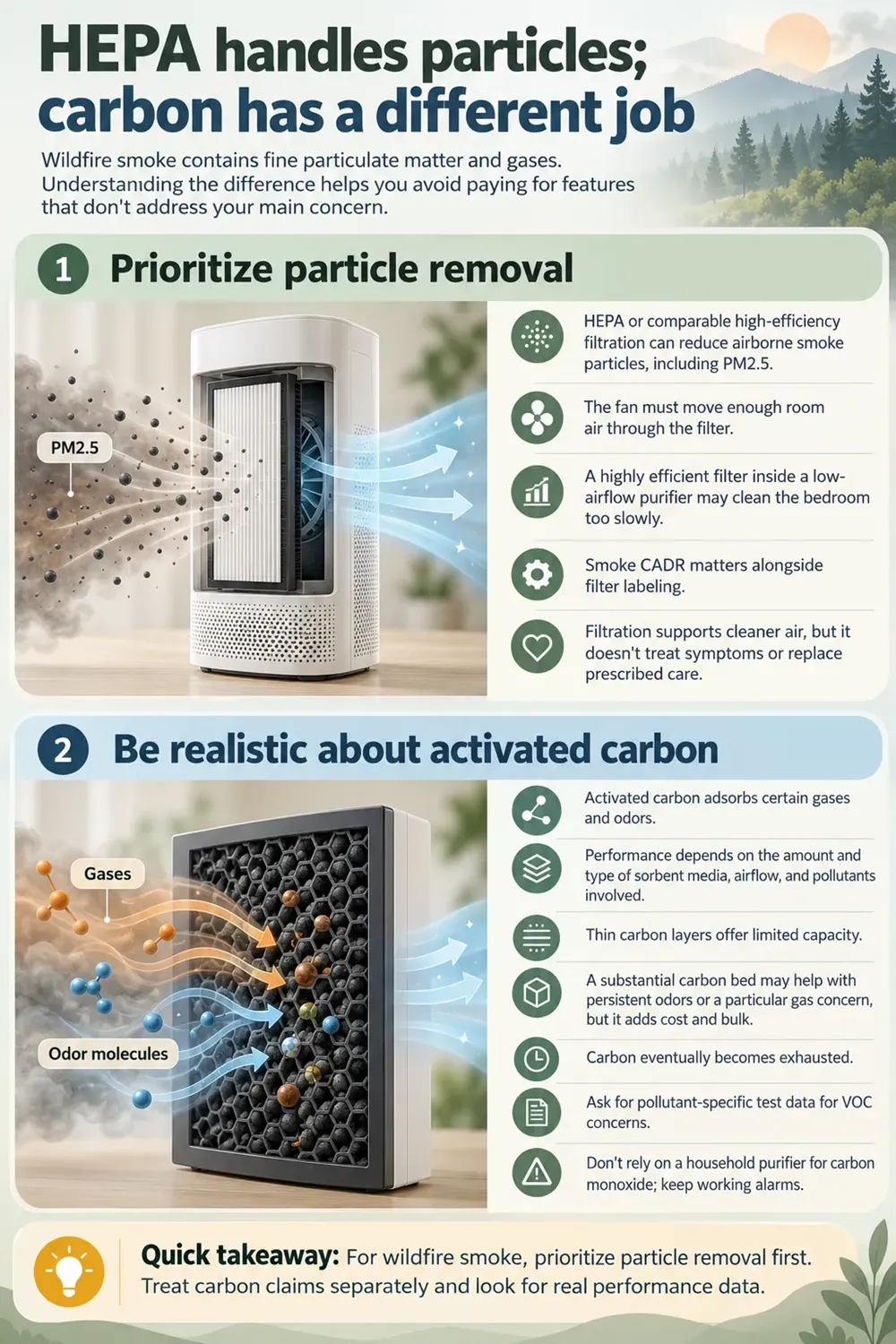
HEPA handles particles; carbon has a different job
Wildfire smoke contains fine particulate matter and gases. Understanding the difference helps you avoid paying for features that don’t address your main concern.
Prioritize particle removal
A HEPA filter or comparable high-efficiency filtration can reduce airborne smoke particles, including PM2.5. The fan must move enough room air through the filter.
A highly efficient filter inside a low-airflow purifier may clean the bedroom too slowly. That’s why smoke CADR matters alongside filter labeling.
PM2.5 can irritate airways and worsen existing heart or lung conditions. EPA’s wildfire smoke health guidance identifies people who may face added health risks and need extra precautions. Filtration supports cleaner air, but it doesn’t treat symptoms or replace prescribed care.
Be realistic about activated carbon
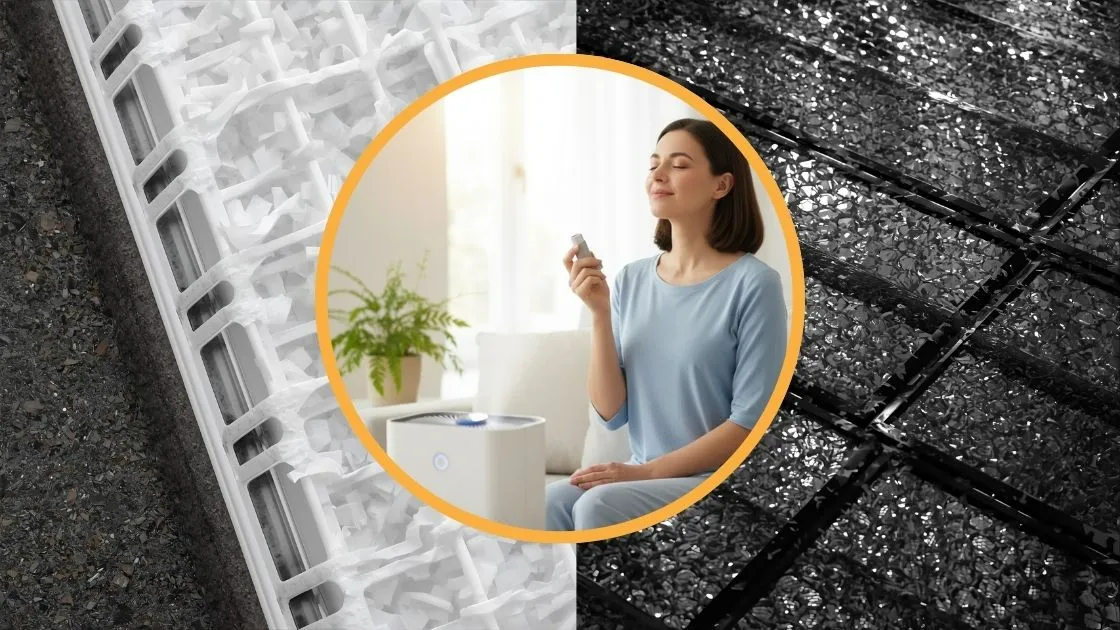
Activated carbon filters adsorb certain gases and odors. Their capacity depends on the amount and type of sorbent media, airflow, and pollutants involved.
Thin carbon layers offer limited capacity. A substantial carbon bed may be worth considering for persistent odors or a particular gas concern, but it adds cost and bulk. Carbon eventually becomes exhausted.
Ask for pollutant-specific test data for concerns such as volatile organic compounds rather than accepting a broad “smoke removal” claim. Don’t rely on a household purifier for carbon monoxide, and keep working alarms where required.
Choose an overnight setting you can sustain
Bedroom noise matters because a purifier helps only while it’s running. Compare noise levels at a setting that provides useful airflow, rather than focusing on the quietest advertised number.
During smoky periods, use continuous operation at the highest setting you can tolerate. Higher airflow before bedtime can help reduce accumulated particles, but it doesn’t replace overnight operation while smoke continues entering.
A purifier’s maximum CADR and minimum noise rating usually describe different fan speed settings. They shouldn’t be treated as simultaneous performance.
Avoid assuming that automatic mode will always respond appropriately. The built-in sensor measures conditions near the purifier, and its programming determines when the fan speeds up.
If particles remain elevated elsewhere, try a higher manual setting. Return policies matter here: steady fan noise, changing speeds, and bright controls can affect sleep differently.
Place the purifier on a stable surface with the manufacturer’s required clearance. Keep curtains, bedding, and furniture away from its intake and outlet. Don’t tuck it into a corner simply to hide it.
Make the bedroom a cleaner-room
A closed bedroom gives one appropriately sized air purifier for wildfire smoke a manageable space to clean. EPA’s clean-room guidance recommends combining filtration with measures that limit incoming smoke.
Keep windows and exterior doors closed when practical. Close the bedroom door, and avoid candles, incense, smoking, or other unnecessary particle sources nearby. If central HVAC is available, use compatible HVAC filters according to the system manufacturer’s instructions, alongside the room purifier.
Cooling needs attention too. A single-hose portable air conditioner exhausts indoor air outdoors. Replacement air can enter through building leaks and bring smoke with it.
EPA’s indoor-air wildfire guidance advises using these units sparingly during smoky conditions. Dual-hose systems reduce this particular pressure problem, although installation and sealing still matter.
Don’t trade smoke protection for dangerous heat. If the room becomes too hot, follow local advice and consider a cooler, cleaner indoor location.
When outdoor air improves, ventilation can help refresh the room. Check conditions before opening windows, rather than relying on whether the air smells smoky. Odor alone isn’t a reliable measure of particle concentration.
Use PM2.5 readings without chasing every fluctuation
A separate particle monitor can help you check whether filtration produces a sustained improvement where you spend time. It doesn’t need to sit beside every appliance.
Place it away from purifier exhaust, direct drafts, cooking plumes, and humidifier mist. Keep its location and equipment settings consistent when comparing readings.
Breathful Living’s guide to interpreting indoor PM2.5 readings explains the difference between particle concentration and an AQI score.
Look for a clear downward trend rather than tiny differences between readings. Consumer sensors have limits, and humidity can affect optical measurements.
A monitor measures an environmental condition. It can’t diagnose symptoms, measure lung function, or determine your personal exposure dose. A low reading also says nothing about gases the device doesn’t measure.
Keep following any prescribed asthma or respiratory action plan. Seek urgent help for severe breathing difficulty or chest pain rather than waiting for a display to change.
A DIY air cleaner can be a useful backup
If commercial purifiers are unavailable or outside your budget, a well-built box-fan cleaner can reduce smoke particles.
The EPA research on DIY air cleaners from the U.S. EPA supports designs using a box fan and MERV 13 filtration. Construction, filter fit, and airflow affect performance.
Follow EPA’s assembly and safety instructions. Use a fan manufactured in 2012 or later with a UL or ETL safety mark. Keep it stable and away from anything that could obstruct airflow.
This is a particle-filtering backup, not a gas-removal solution. Bedroom drawbacks include size and fan noise.
When available, a commercial purifier with known CADR is easier to size. Neither option replaces evacuation instructions or other local emergency guidance.
Key takeaways
- Choose documented smoke CADR for your bedroom, with extra capacity if you need quieter operation.
- Treat activated-carbon claims separately from particle-filtration performance.
- Keep one room closed and filtered without allowing dangerous heat.
- Check sustained particle trends, while keeping monitor readings separate from medical decisions.
Common buying questions
Should I replace the filter after every smoke event?
There isn’t a universal replacement interval for wildfire exposure. Follow the manufacturer’s guidance, inspect the filter, and check for reduced airflow or persistent odor.
Clean a washable prefilter as instructed, but don’t wash the main filter unless its manufacturer explicitly permits it. Heavy smoke can shorten filter life.
Before buying, check the correct replacement filter’s price and availability. A discounted purifier can become expensive if replacement filters are costly.
Does lingering smoke odor mean the purifier isn’t working?
Particle removal and odor reduction are different jobs. Activated carbon filters may reduce some gases and odors, but a purifier can reduce particles while some odor remains.
Odor may come from gases or smoke residues on furnishings. Increasing particle filtration won’t necessarily address those sources. A particle monitor can show trends, but it can’t confirm that gaseous pollutants have been removed.
Choose for the room you’ll sleep in
Choose an air purifier for wildfire smoke with documented smoke airflow and a sustainable overnight setting for continuous operation. Start with room size, then compare controls, filtration design, and replacement costs.
Support the purifier with a closed, comfortably cool room and fewer indoor particle sources. Usable airflow throughout the night matters more than a box’s high airflow or coverage claim.