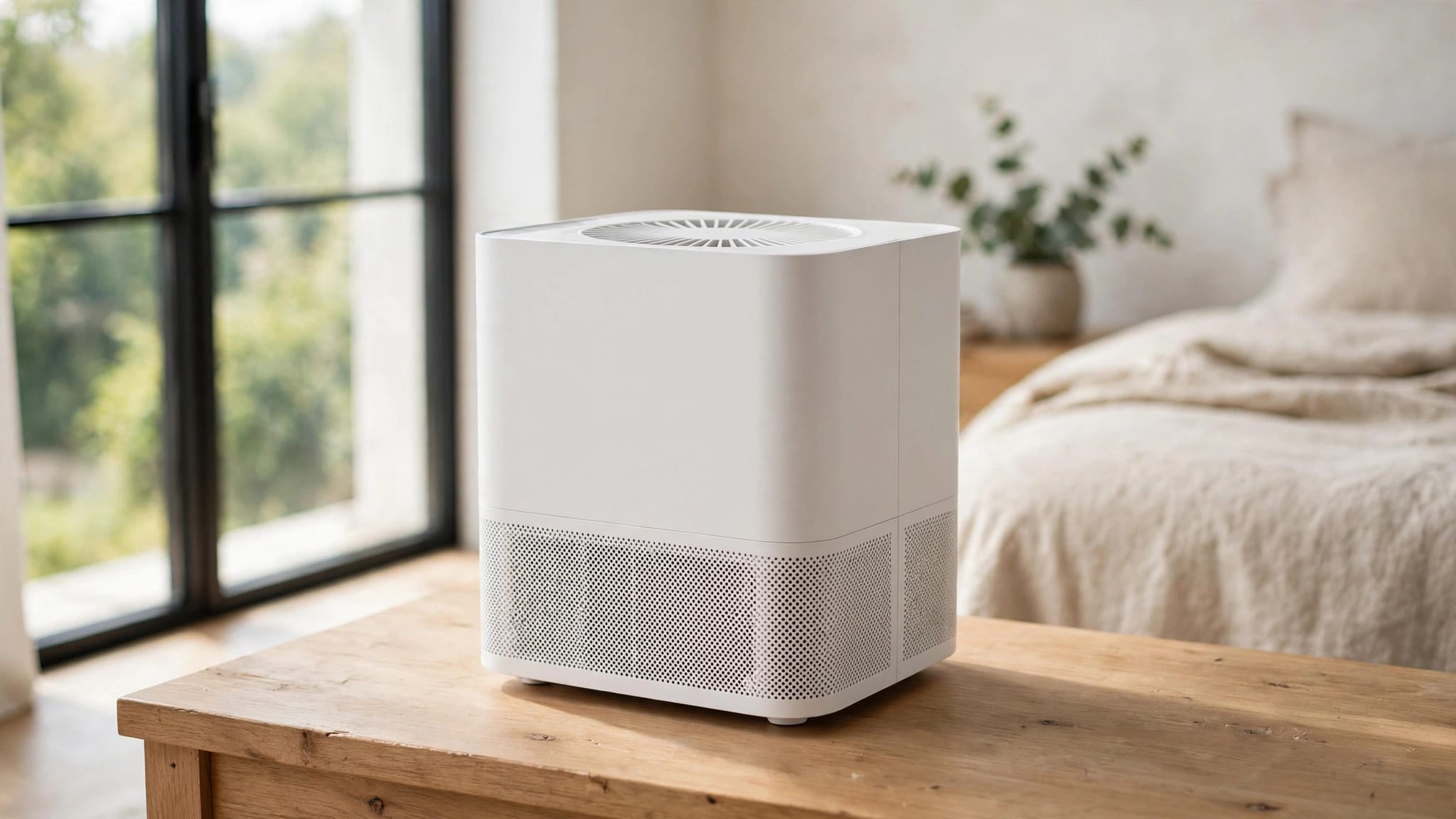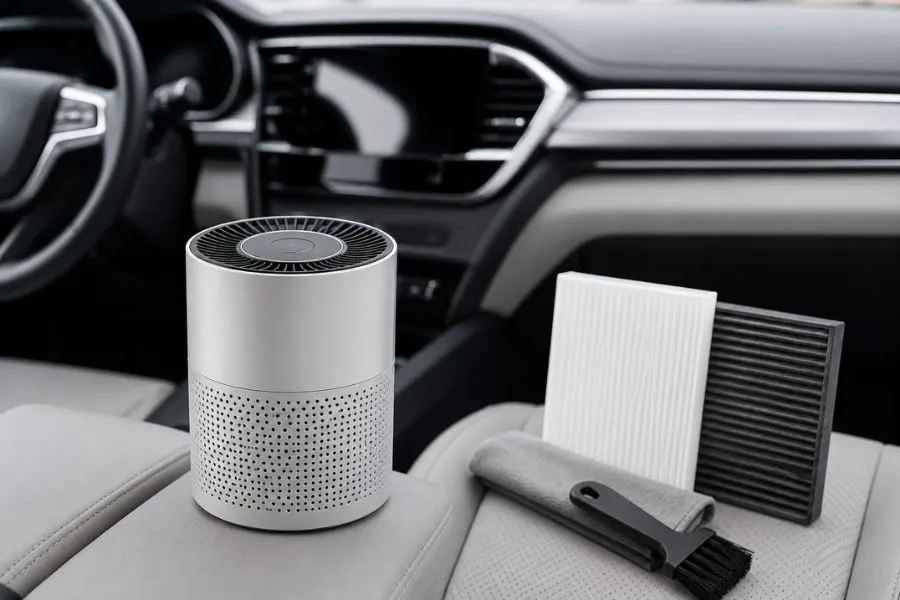
A good air purifier can reduce airborne pet dander when its filtration and airflow match your room. For everyday shedding, the Levoit Vital 200S-P is a practical starting point; the Coway Airmega 150 suits smaller bedrooms, while the Coway Airmega 250 serves larger rooms.
Your purifier should support a manageable cleaning routine, not replace it. The most useful features are enough clean airflow, effective particle filtration and a pre-filter you can maintain easily. Start with the room where you spend the most time.
Best air purifiers for pet dander at a glance
These three models suit different room sizes and everyday priorities.
| Product | Best for | Main trade-off | Check Pricing |
|---|---|---|---|
| Levoit Vital 200S-P, mid-range | Medium rooms and frequent shedding | Combined replacement filter | Check Levoit pricing |
| Coway Airmega 150, mid-range | Smaller bedrooms and straightforward controls | Limited large-room airflow | Check Coway 150 pricing |
| Coway Airmega 250, mid-range | Larger rooms and simple operation | Disposable pre-filters | Check Coway Airmeg 250 pricing |
Coverage only makes sense alongside air changes per hour. A large square feet rating may describe much slower cleaning than the CADR suggests.
Why Pet Dander Matters for Your Lungs
Pet allergens are tiny, sticky particles from skin flakes, saliva and urine. They stay airborne for hours and settle on furniture and bedding, so you breathe them in long after your pet has left the room. For people with allergies or asthma, they are a common trigger for sneezing, coughing and wheezing. A HEPA air purifier sized for your room reduces how much of these allergens you breathe, especially in the bedroom, where you spend a third of your day
Levoit Vital 200S-P: Best Air Purifier for Pet Dander Overall
Choose the Vital 200S-P for a medium-sized living room where pet hair collects regularly and airborne pet dander is a concern. Its published CADR is 250 cubic feet per minute, with coverage around 388 square feet, or 36 square meters, at 4.8 air changes per hour.

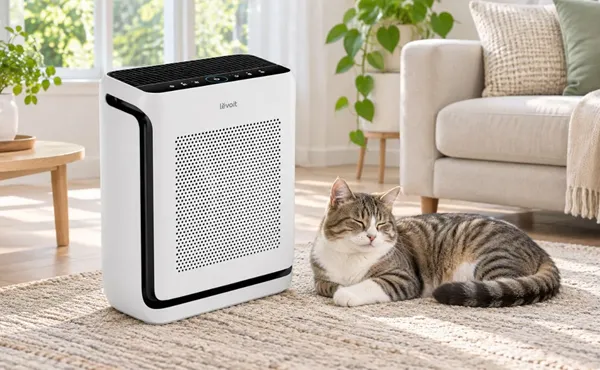
A washable pre-filter catches loose fur before it reaches the main filter. A U-shaped inlet, three-stage filtration and app controls make it a practical fit for busy pet households.
Who should choose something else?
Skip this model if your connected living space needs more airflow, or litter-box odor is your main concern. Its activated carbon layer doesn’t replace source cleaning or ventilation for pet odor.
The main upkeep trade-off is its combined replacement filter. Washing the pre-filter helps protect it, but doesn’t make the particle and carbon layers reusable.
Choose the Vital 200S-P when washable hair capture and medium-room airflow matter more than a compact footprint.
Bedroom and larger-room alternatives
Coway Airmega 150: Best Air Purifier for Pet Allergies in Small Bedrooms
Choose the Airmega 150 for a smaller bedroom with straightforward controls. Its main trade-off is lower airflow capacity, not the lack of an app.
Coway’s published CADR figures are 153 CFM for smoke, 161 CFM for dust and 220 CFM for pollen.

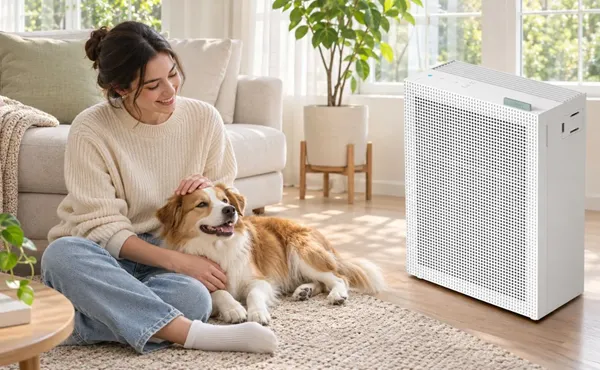
Its stated coverage is 214 square feet, approximately 20 square meters, at 4.8 air changes per hour. The filtration system combines a washable pre-filter, deodorization filter and HEPA filter.
The removable pre-filter makes routine pet hair removal easier. That keeps maintenance manageable as part of an ordinary morning.
Avoid it for open-plan living areas.
Choose the Airmega 150 for a smaller room where easy maintenance and physical controls suit your routine.
Coway Airmega 250: Best Air Purifier for Pet Dander in Large Rooms
The Coway Airmega 250 combines effective particle filtration with quiet, automatic operation, making it well suited to bedrooms shared with cats or dogs. Its washable pre-filter captures pet hair, while the HEPA filter helps reduce smaller airborne particles that carry pet allergens. Smart Mode responds to changing air quality, and Sleep Mode keeps noise and lighting low overnight.

In the UK or Europe? The Airmega 250 is a US model built for 120 V. A simple plug adapter is not enough, as it only changes the plug, not the voltage. It would need a step-down voltage converter, and the US warranty usually doesn’t cover use abroad. The safer choice for a large room in Europe is the Levoit Core 600S, which Levoit sells in the UK and EU.
How we chose and other good options
How we chose
These recommendations prioritize published CADR, clear room-size information, particle filtration and manageable pet-hair maintenance. The selections focus on documented specifications.
A washable pre-filter gets extra weight because shedding creates ongoing work. Carbon can help with odors, but its presence alone doesn’t establish strong litter-box odor removal.
Other good options
These are room purifiers, not whole-home systems.
The Levoit Vital 100S-P is a smaller alternative with a washable pre-filter and coverage of 222 square feet at 4.8 air changes per hour. It misses the main shortlist because the Vital 200S-P gives you more airflow headroom.
The Austin Air HealthMate Junior combines HEPA and carbon filtration in a steel housing, with a claimed filter life of up to five years. Its premium positioning makes it a different purchase from these mid-range everyday options.
For connected rooms or a much larger living area, our large-room air purifier guide offers a broader comparison.
Match the filters and airflow to your home
What each filter actually does
Pet allergies involve proteins, including Fel d 1 in cats and Can f 1 in dogs. Pet allergens occur in dander, saliva and urine, so removing visible fur doesn’t remove all pet dander or other airborne allergens.
According to the EPA’s HEPA definition, a HEPA filter captures at least 99.97% of particles at 0.3 microns. That figure describes filter efficiency, not the share of allergens removed from an entire room.
“HEPA-like” and “HEPA-style” don’t guarantee that performance. Our HEPA filter buying guide explains the distinction.
If you use an air-quality monitor alongside your purifier, our guide to reading PM2.5 levels explains what the particle readings mean and how to track changes over time.
Pre-filters catch hair and fluff. Washable versions reduce disposable purchases. Odorous gases, including volatile organic compounds, pass through HEPA media; activated carbon has a separate role. The EPA’s air-cleaner guidance notes that gas removal needs substantial sorbent material.
Calculate room size using CADR
AHAM’s two-thirds rule recommends a smoke clean-air delivery rate of at least two-thirds of the room’s floor area in square feet, for typical eight-foot ceilings.
For a 12-by-15-foot bedroom with an eight-foot ceiling:
- Multiply length by width: 180 square feet.
- Calculate room volume: 1,440 cubic feet.
- At 150 CFM, calculate 150 × 60 ÷ 1,440: about 6.25 air changes per hour.
Roughly four to six air changes per hour is a useful planning range, not a promised health outcome. AHAM room ratings use 4.8.
A purifier advertised for 1,000 square feet at one air change per hour serves only about 208 square feet at 4.8.
Published ratings generally reflect maximum speed. Taller ceilings, open doorways and quieter fan settings affect practical coverage. These ratings describe room-level performance; whole-home coverage and in-duct purification are separate considerations.
Placement, upkeep and whole-home support
Keep airflow open and use a steady setting
For good placement, put your purifier in the room you use most, away from curtains, furniture and corners. Match its rating to the room’s square feet, leave about a foot of clearance where the manual allows, and never block the intake or outlet.
For a bedroom, choose a steady fan setting you can sleep beside. A low advertised noise figure doesn’t tell you how much clean air sleep mode delivers.
Keep cords away from pets and children. Avoid ozone generators and ionizers that produce ozone; UV-C isn’t necessary for routine dander filtration. Ozone can irritate the lungs.
For persistent symptoms, talk with your doctor about an allergy-management plan.
Maintain the filters and remove settled allergens
Inspect the pre-filter regularly during shedding season to clear pet hair. Wash only parts labeled washable, and let them dry fully before refitting. Don’t wash HEPA media.
Activated carbon gradually saturates. Returning odors can signal replacement is due, even when particle filtration still works. For ownership costs, budget for each filter’s replacement frequency plus electricity, rather than assuming every filter lasts a year.
Vacuum upholstery and wash pet bedding because purifiers can’t collect allergens that remain settled. For cats, litter-box cleaning and ventilation address odor at its source; for dogs, regular fur removal protects airflow.
Compatible HVAC filters can support whole-home particle control. In-duct purification isn’t automatically necessary, and routine duct cleaning hasn’t demonstrated health benefits.

Frequently asked questions
Do air purifiers work for dog allergies?
They can reduce airborne particles that carry allergens, including dog dander. A HEPA filter can capture particles carrying Can f 1, the main dog allergen, but it won’t remove allergens already settled on carpets, bedding or furniture. For people with pet allergies, use filtration alongside regular cleaning and expect reduced exposure, not guaranteed symptom relief.
Do air purifiers help with cat allergies?
Yes, a true HEPA purifier can reduce airborne cat allergen (Fel d 1), which is especially light and stays in the air for a long time. Combine it with washing bedding weekly and keeping the cat out of the bedroom for the best effect.
Are air purifiers safe for cats and dogs?
HEPA purifiers are safe for pets. Avoid ozone generators and ionizers that produce ozone, which can irritate both human and animal lungs. Keep cords out of reach of chewing pets.
Can you run an air purifier continuously?
Yes, if the model is designed for continuous operation and you follow its electrical and maintenance instructions. Keep airflow clear and cords out of reach of chewing pets. Choose mechanical filtration without ozone-producing features.
Will a purifier remove litter-box odor?
Activated carbon can reduce some odor-causing gases, but a thin layer has limited capacity. Particle filters handle particles, not gases. Start with litter-box hygiene and suitable ventilation. If pet odor is your main concern, carbon quantity matters more than a pet-themed product name.
Choose for the room you actually use
The strongest choice is a purifier with enough airflow for your space and maintenance you can keep up with. A room purifier is chosen for one room, not whole-home coverage. Expensive features won’t compensate for a unit that’s too small.
Measure your main room first. Start with the Levoit Vital 200S-P for medium-room shedding, the Coway Airmega 150 for a smaller bedroom, or the Coway Airmega 250 for a larger room. Then give it good placement, open airflow, and a regular filter-care routine.